
The PM Job Is Multiplayer. Most Product AI Tools Are Single Player.
AI made product artifacts cheap to produce. The number of people who have to understand and agree with each one stayed exactly the same.

Jeremy Freeman
Co-Founder & CTO
Date
August 25, 2026
Tags
Strategy & Thought Leadership
Community
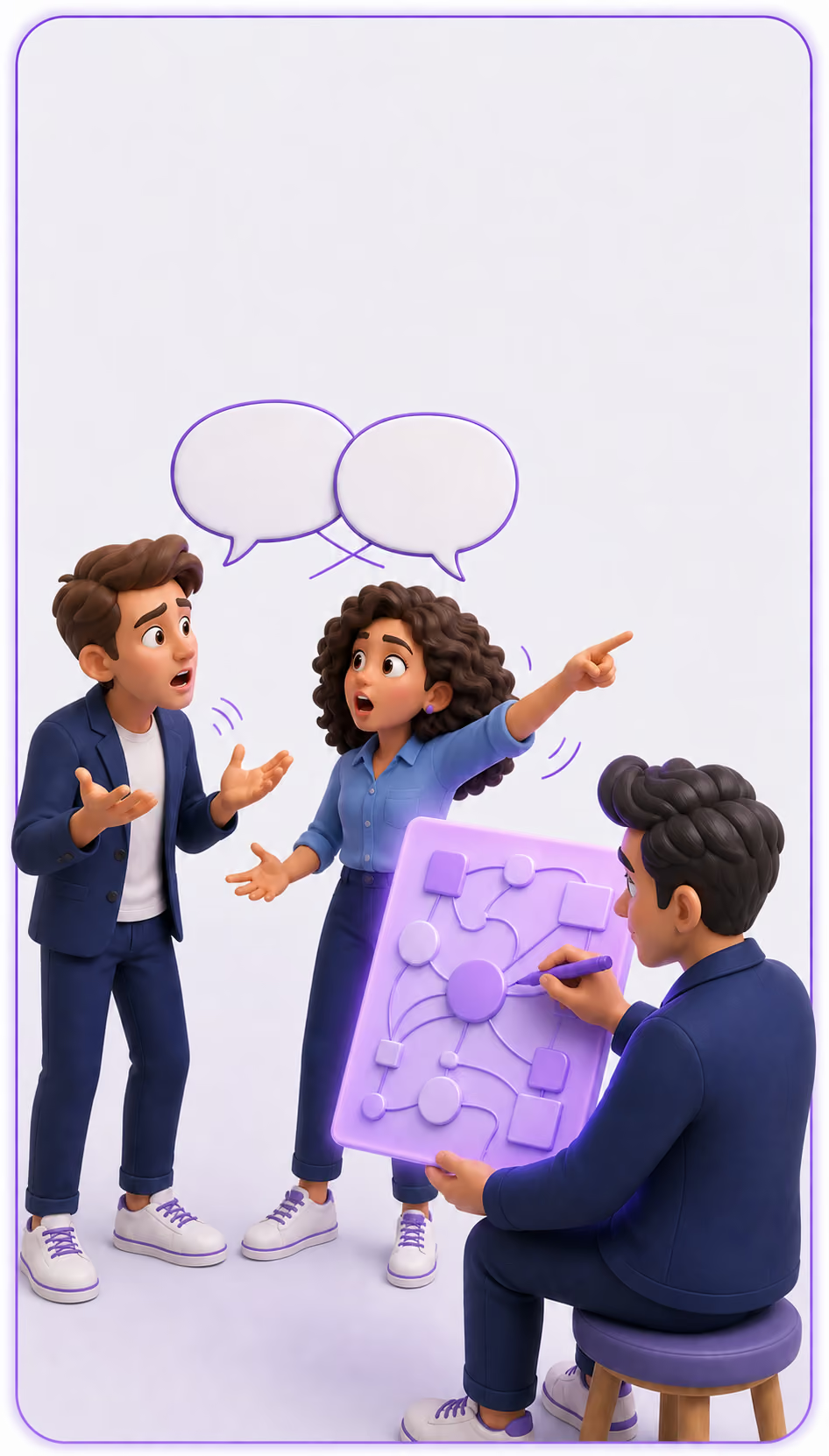
Have you ever built an artifact to get feedback on, a doc, a deck, a prototype, only to watch it die on the vine?
I watched it happen a few weeks ago, and it was a good document, or at least it started as a good idea. Someone on the team had a real insight, sat down with Claude, and twenty minutes later had fourteen pages, thorough, confident, and somehow off. Too long, a little bloated, wandering into territory nobody had asked about. It went into a channel, two people skimmed it, one left a comment on a section that didn't matter, and then... nothing. No pushback, no debate, no "wait, that's not what I meant." The conversation that document existed to start never started.
It wasn't a fluke, either, I've seen the same pattern inside my own company, in teams I've worked with, in founders I've compared notes with, and it's new. We're all producing more product artifacts than we ever have, faster than we ever have, and the alignment feels worse. Something changed in the last year, and it's still changing month to month. Nobody has the full picture yet, me included. So let me lay out what I'm seeing, because I think we're all figuring this out at the same time.
Start with the part of the job that hasn't changed
Watch what product people actually do all day, not the job description, the actual hours, and a pattern emerges. Ani Ganti nailed it back in 2022, before AI tools were even part of the picture: he called it the alignment tax. The majority of a PM's real time goes not to the artifacts but to storytelling, selling a vision and roadmap to stakeholders, over and over, to build shared understanding. The tool requirements must therefore adapt to AI product management tools that help them carry the story, make the tradeoffs, and ensure the context and intent are clear in requirements and specs.
He's right, and I'd put it even more plainly: most of the job is sales. Not closing deals or pushing paper, selling ideas. To engineers who have to build them, to executives who have to fund them, to sales and CS teams who carry them into rooms you'll never enter, to customers who have to bet a workflow on them. You pitch, you gather feedback, you synthesize, and then you present that synthesis back to the same people to collect the next round.
The document is the visible output, but anyone who's done this work knows the contents take shape long before the writing session begins. Product people are among the tech professionals who don't really get to turn off, ideas keep churning until they land in the correct shape. It's a creative endeavor, and creatives are always on this way.
Here's the subtle part about the feedback in this loop: it usually isn't a spec. When a stakeholder pushes back on your idea, often they're not filing a requirement, they're processing the idea out loud, and the pushback is how you know it's happening. Some feedback you implement, some you hedge and discount, and some you push through, knowing where to hold and where to fold is as much the job as anything that lands in the PRD.
I've spent a decade as a founder watching this cycle run across teams and other founders, and it has a predictable arc. At the start it's you, an idea, and your intuition. Then the first real feedback arrives, and you have the genuinely hard job of meshing your vision with the world as it actually is. Eventually, with a real user base, you're weighing a swarm of plausible-sounding "dark mode" requests against the actual core of the value prop. At each stage the sale changes , first you're selling a pure idea, then trust that the thing will be magical, then confidence that your priorities are the right ones. But the shape stays the same: a conversation to navigate, chew on, and put to paper so it can fuel the next conversation.
The thing to notice is that this loop runs through other people. The job is multiplayer.
Now look at where AI actually shows up
Here's where it gets interesting: Lenny and Noam Segal ran a large survey on how tech workers use AI in late 2025, and the PM results are striking. The top uses were writing PRDs, building prototypes, and polishing communications. Production tasks, the last mile of getting a formed thought out of your head and onto paper. Strategic and discovery work sat near the bottom of the list.
That matches my experience: AI has become a genuinely great thinking partner, and I use it to ideate, to chew on ideas, to pressure-test arguments constantly. But notice what the ideating, the chewing, and the writing all have in common: they're the individual parts of the work. One person, one context window, one artifact out the other side.
The selling, the multiplayer part, happens somewhere else. It happens in rooms and threads and hallway conversations where the AI that helped draft the document isn't present and has no idea what happened. Which brings me back to that fourteen-page document dying in a Slack channel. The single-player tool did its job perfectly. The multiplayer job never even started.
We've seen this movie before
When AI coding agents exploded over the last two years, the bottleneck in software teams didn't disappear, it moved. Developers went from being limited by how fast they could write code to being swamped by how fast they could understand code they didn't write. Review queues piled up with what people started calling comprehension debt . And within months, a wave of AI code review tools appeared to attack the new bottleneck. The industry accelerated the production side of the loop, then scrambled to reinforce the consumption side.
Product work is running the same arc, about eighteen months behind. ChatGPT was our "ship PRDs faster" moment. Most of the current product AI platforms are, roughly, "take a pile of feedback, ship the next PRD", a tighter cycle, but the same shape: accelerate the individual's throughput. Meanwhile, the number of stakeholders who need to genuinely understand and buy into each artifact hasn't changed, and their hours in the day haven't changed either.
One respondent in Lenny's sentiment survey from just last month put it in one line: "We just set a new denominator for the job. And it moves higher and higher every month." If the alignment tax was already the expensive part, then every gain in production speed compounds it. More documents per unit of shared understanding isn't progress, it's the tax compounding.
There's a demand signal hiding in the same research, if you look for it. The single biggest gap between where PMs use AI today and where they want to use it is user research, the messy, upstream, human-understanding work. Only a handful use AI there now; nearly a third want to. That's PMs telling the market, loudly, that the last mile was never the problem.
What would it look like if the tools were multiplayer?
I don't have a finished answer here, but I have a picture.
There are early pushes in the right direction, and more shipping every month. AI notetakers sit in meetings now; agents live in Slack channels; feedback gets summarized automatically. It's useful, but most of it is transcription, a recording of the multiplayer session, not a player in it. The conversation happens, and afterward the AI tells you what was said, which is solving the wrong layer.
Picture the courtroom sketch artist, the really talented one. Two lawyers are arguing an idea back and forth, gesturing, contradicting each other, talking past each other. The sketch artist isn't interrupting, and isn't waiting for one lawyer to go home and dictate a summary. They're absorbing the whole exchange, and at the right moment they turn the paper around, and there it is. The thing everyone was circling, captured in an artifact concrete enough to point at, argue with, and drive forward. The artifact doesn't end the conversation, it advances it.
What would that look like in product work? A prototype that doesn't just get built from a spec, but sits in the room while people react to it, takes its own feedback, iterates itself in front of the group, surfaces the directions the conversation implies but nobody has said out loud yet. An artifact as a participant in the selling process, rather than an exhibit the PM has to defend alone.
And notice what that does to the failure mode I started with. The fourteen-page document died because it was a one-way broadcast, all the context lived in one person's head and one chat session, and the audience was asked to reconstruct it cold. If the shared conversation becomes the source of truth, the artifacts become checkpoints the group produces together: smaller, sharper, already carrying everyone's fingerprints by the time they exist. And people fight for things they helped shape — that's not a new insight about AI, it's the oldest insight in selling.
Jeff Keyes on Stacked Sessions, spoke with Curtis Sherbo about how AthenaHealth is already making prototyping a job for everyone. You can read about how this is already starting to play out in teams.
An open question
To be fair to today's tools: they aren't bad, the productivity gains are real, and the research on that is about as unambiguous as this kind of research gets. And the human work doesn't go away. Reading the room, deciding where to hold and where to fold, spending relationship capital, that stays with us, and it should.
But here's what I think is actually going on. Almost everything built for product work so far is shaped by what we could imagine once ChatGPT became universal: take the existing workflow, the doc, the feedback pile, the roadmap deck, and put a chat window next to each piece. That was the obvious first move, and it worked, which is exactly why we've stopped there. The result is that we've spent two years accelerating a workflow that was designed for a world without AI. The single-player shape of these tools isn't a law of nature, it's an artifact of where our imagination started.
So the question isn't just how to make AI a participant in the product conversation rather than a faster assistant beside it, though I'd genuinely like your read on that. The bigger question is this: if you set the current workflow aside and reimagined the whole PM job as an AI-first workflow, the selling, the feedback loops, the alignment work, all of it designed around AI as a participant from the start, what would you build? Honestly, I can't remember being this excited about an open problem. I have thoughts forming, enough for another post, and eventually, I want to build toward the answer. But first I want to know whether this looks as big from where you sit as it does from where I do.
Please share with me your thoughts at productstudio@allstacksai.com or send me a message on LinkedIn.
Table of contents

/ get started /