
Allstacks Launches Product Studio: An Always on Product Partner with Complete Context
Allstacks Product Studio is the always-on workspace for product and engineering teams to build context-aware specs that hold up in AI-assisted development.

Hersh Tapadia
Co-Founder & CEO
Date
June 1, 2026
Tags
Company News
News & Press
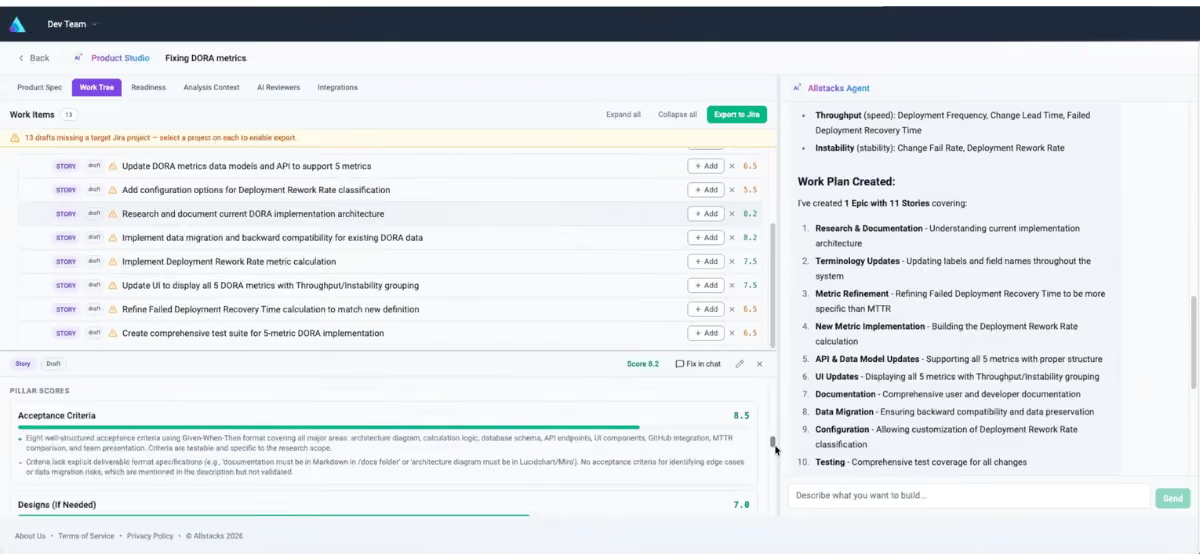
Today we're launching Product Studio, an always-on workspace where product and engineering teams build the specifications AI coding agents actually need to work from. It is the AI tool for product management as part of the Allstacks Platform.
The reason we built it traces back to a pattern showing up across the industry.
Engineering throughput reports across companies running AI coding tools in production show individual developer productivity climbing while organizational throughput and delivery velocity stay flat. Product roadmap reports from the same organizations show quarterly commitments slipping, with launch dates that looked safe at sprint planning going red around week six. Industry research over the last two years has documented both halves of this pattern. Most leadership teams are still treating them as separate problems. They aren't. AI coding tools amplified whatever spec quality teams already had, and the gaps that used to surface in grooming now ship as code.
The mechanics matter here. The old model worked because tribal knowledge filled the gaps. A PM wrote a ticket. The engineer who picked it up knew the codebase, the customer, the past five things the team tried that didn't work, and the Slack thread from two weeks ago that quietly changed the scope. The ticket was a starting point. Grooming was where the spec got finished.
That safety net is gone when an agent does the building.
The agent takes the spec and writes code against it. It doesn't pause for clarifying questions. It doesn't carry tribal knowledge. If the spec doesn't include the institutional memory the senior engineer would have brought to grooming, the agent invents its own, which is how teams end up with phantom requirements, duplicated logic, and patterns that drift from how the rest of the codebase already works.
Spec quality is the upstream control on AI code quality. When half of product and engineering teams say ticket quality already creates drag on their sprints, the issue is product definition, not tooling. The compounding cost shows up as rework, production instability, and budget lines nobody can trace back to the original ambiguity.
Why product requirements for AI coding need a different workspace
The fix isn't a better prompt or a stricter spec template. A PM cannot write a brownfield-aware spec from a template. The context that matters most for AI coding lives in the codebase itself: which services already handle this concern, which APIs return what shape, which feature toggles are still active, which auth paths are deprecated but still live in three places.
Confluence docs don't carry that context. Jira tickets don't carry it. It lives in engineering's collective memory and in the code, and the PM has no way to reach it at the depth required.
Telling AI to write software without that context is like telling a stranger to build an engine without blueprints. The stranger will build something. It won't be what you wanted, and you'll spend more time fixing it than you saved.
What Product Studio does
Product Studio is the workspace where product and engineering build the spec together, with the same context a senior product and engineering manager would have. That context lives in the same workspace your team uses to draft, and it flows through to the agents that build downstream.
Teams use Product Studio to do three things:
Define what to build. Draft feature requirements and specifications grounded in your actual codebase, delivery history, customer voice, and strategy documents. The architectural context relevant to the work assembles around the PM before they write the first sentence.
Refine before you ship the spec. Adversarial AI reviewers score every spec against engineering feasibility, team capacity, security, and historical rework rates. The pre-mortem happens before the work is green-lit, with findings the PM can act on while still in the drafting surface.
Share build-ready packages. Send refined specs, readiness-scored work plans, and adversarial review findings to your team or to the AI agents that will build from them. Engineering reads a spec that already survived the questions a senior engineer would have asked at grooming.
The mechanism is the same context graph that powers the rest of our platform. We've applied it to the part of the lifecycle where the most damage gets done when teams get it wrong.
Why now
The market has a few partial answers to this problem. In-house context layers built on frontier LLMs work against whatever systems the team remembers to load. Purpose-built requirement tools generate structured specs without connection to the codebase, delivery history, or actual team capacity, so the specs land in engineering as untested assumptions. Neither approach combines the breadth of context, the agent harness to act on it, and the discipline to keep product intent aligned with engineering execution through the build.
If you're struggling to share context, move faster, and build the right things, Allstacks Product Studio is built for you to plan smarter, and build better by helping you decide, define, and refine product and feature requirements and specs with evidence. Allstacks Product Studio. Start free today.
Table of contents


/ get started /