
The Orchestration Gap: What Anthropic's Report Means for Engineering Leaders
AI writes more code every quarter, but engineers still supervise 80%+ of what they delegate. Inside the 2026 orchestration gap.

Gage Hollen
Senior Product Marketing Manager
Date
April 23, 2026
Tags
Industry News
The Oversight Number That Should Stop Every Engineering Leader
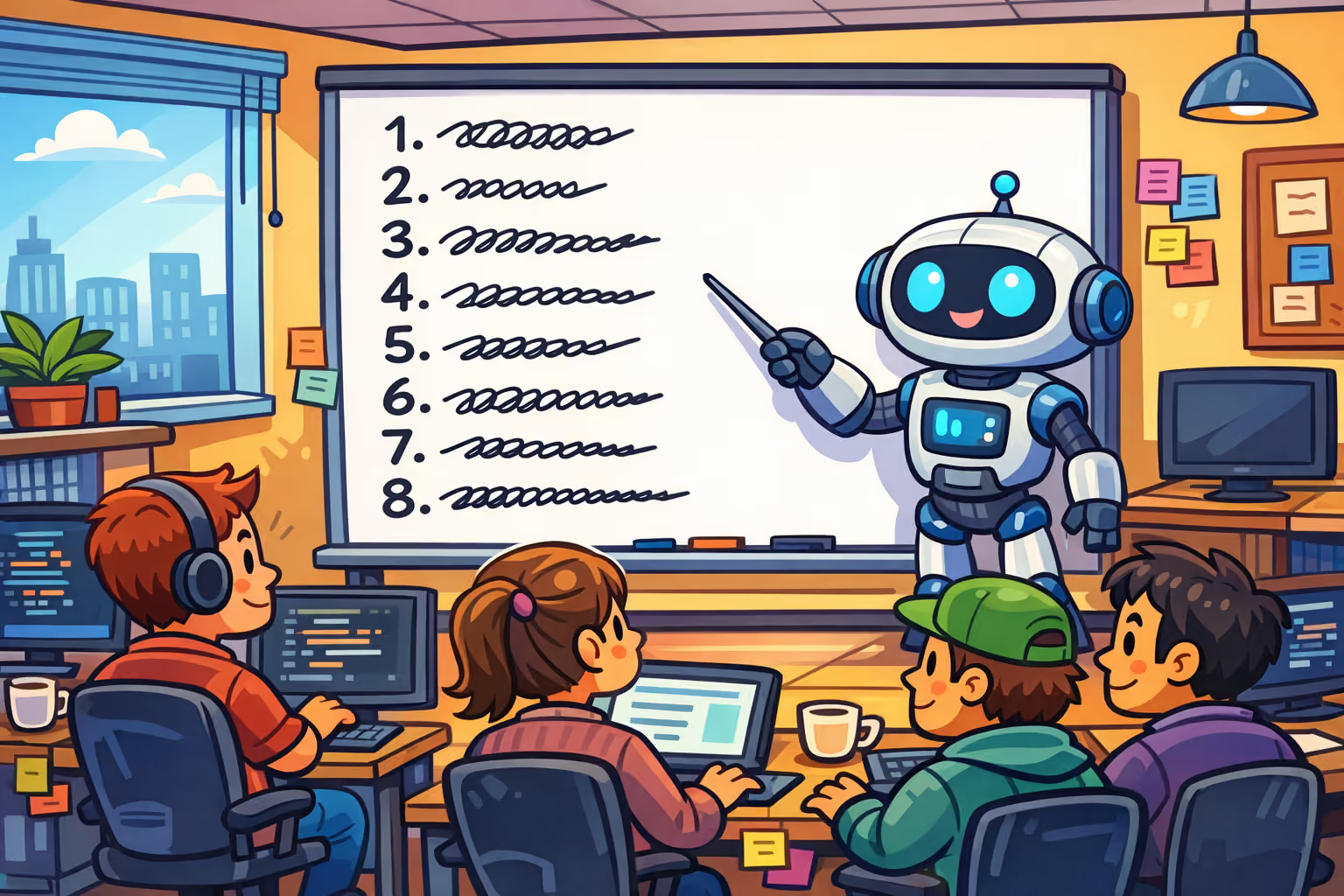
Developers who use AI tools can only "fully delegate" 0 to 20% of tasks, according to Anthropic's own research in the 2026 Agentic Coding Trends Report. They integrate AI in roughly 60% of their work, but actively supervise 80 to 100% of what they delegate.
This is not a temporary gap that will close when models improve. It reflects the fundamental architecture of how humans and AI build software together. And it has direct consequences for how engineering organizations need to think about leadership, visibility, and scale.
The Shift Most Engineering Leaders Haven't Fully Accounted For
The Anthropic report maps eight trends it predicts will define agentic coding in 2026. But three of them compound into a problem most engineering organizations are not yet equipped to handle.
The first is role transformation. As the report puts it, "the primary human role in building software is orchestrating AI agents that write code, evaluating their output, providing strategic direction, and ensuring the system solves the right problems." That is a structural shift in what engineering leadership means, operating at a different altitude than incremental change in how engineers spend their time.
The second is coordination complexity. Single agents are giving way to multi-agent systems. A company in the report named Fountain, a frontline workforce management platform, deployed a hierarchical multi-agent architecture with a central orchestration agent coordinating specialized sub-agents for screening, document generation, and sentiment analysis. When a single product orchestrates that many specialized agents under central coordination, the question stops being "is my one agent working?" and becomes "can I see across the entire hierarchy?" That is a visibility problem no dashboard solves. It becomes an intelligence problem.
The third is the oversight scaling challenge. The report is direct: "The key to success lies in understanding that the goal isn't to remove humans from the loop, it's to make human expertise count where it matters most." TELUS, another mentioned in the report, operates at a scale where that principle is no longer optional: 13,000 custom AI solutions in production, 30% faster code shipping, 500,000 hours saved. At that level of AI integration, manual review is not a strategy an engineering organization can choose. Signal infrastructure is the only way to know where quality is holding, which agent workflows are drifting, and where human judgment actually needs to land.
What connects all three trends: oversight at scale is not a manual activity. It requires a continuous signal layer across the agentic SDLC.
What Good Looks Like at Scale
The engineering organizations navigating this transition well share a common pattern. They have built systems that surface what actually needs a human decision instead of reviewing everything.
This distinction matters because the alternative, reviewing agent output the same way teams review human-written code, does not scale. Engineers who master orchestration can shepherd multiple features through development simultaneously. That multiplies output volume substantially. It does not multiply the hours available for review.
The upstream intervention point is specification quality. The Anthropic report is explicit that agents excel at "tasks that are easily verifiable, well-defined, or repetitive." They fail expensively when the input is ambiguous or under-specified. This is exactly why validating specification quality before agents build at scale produces a different result than catching problems after they have propagated through the system.
Downstream, the signal layer determines which agent-generated PRs warrant attention, where delivery predictability is degrading, and which features are accumulating quality risk before they reach production. Engineers can then focus their judgment where it has the highest leverage, rather than distributing attention evenly across everything agents produce.
This is the core premise of Agentic Software Engineering Intelligence: the infrastructure layer that makes human oversight count at agent-generated scale. The Allstacks platform is designed specifically for this orchestration layer. Rather than adding to an overloaded review queue, it proactively surfaces the signals that require engineering judgment: quality degradation patterns, delivery risk concentration, and alignment gaps between what agents are building and what the business actually needs. Allstacks Product Studio addresses the upstream intervention point directly, validating specification clarity before agents begin building.
The Infrastructure Decision Is an Organizational Strategy Decision
The Anthropic report closes with four priorities: master multi-agent coordination, scale human oversight through intelligent collaboration, extend agentic coding beyond engineering, and embed security architecture from the start.
Every one of these assumes the same foundation: engineering leaders need intelligent infrastructure to see across the output their agents are producing. Organizations that build that infrastructure in 2026 will define what is competitively possible. Organizations that treat it as a later-stage problem will encounter the oversight gap when it is already a production incident or a delivery failure.
The shift from implementer to orchestrator is already happening. The question is whether engineering leaders have the signal infrastructure to operate effectively at the scale that shift enables.
Frequently Asked Questions
What is the "oversight gap" in agentic coding?
The oversight gap is the structural mismatch between how much work AI can take on and how much a human still has to supervise. According to Anthropic's 2026 Agentic Coding Trends Report, developers fully delegate only 0 to 20% of tasks to AI but actively supervise 80 to 100% of what they delegate. As agents produce more code, review capacity does not scale at the same rate, creating a widening visibility and quality gap.
What are the key takeaways from Anthropic's 2026 Agentic Coding Trends Report?
The report identifies eight shifts, but three compound into the most urgent challenge for engineering leaders: (1) the human role is shifting from implementer to orchestrator of AI agents; (2) single agents are giving way to multi-agent coordination, as seen in Fountain's hierarchical architecture; and (3) oversight must scale through systems, not manual review. TELUS running 13,000 custom AI solutions in production is the scale at which that becomes non-negotiable.
What does "orchestrating AI agents" actually mean for engineering leaders?
The Anthropic report defines the new leadership role as "orchestrating AI agents that write code, evaluating their output, providing strategic direction, and ensuring the system solves the right problems." In practice, this means shifting from reviewing individual pull requests to designing the systems that surface which PRs, specs, and delivery signals need human judgment.
Why won't better AI models close the oversight gap?
Because the gap is structural, not capability-driven. Anthropic's research shows the 80 to 100% supervision rate reflects how humans and AI build software together. Specifications get interpreted, trade-offs get made, and quality has to be verified against business intent. Better models make agents faster and broader, which increases the volume of output to oversee rather than reducing it.
How should engineering organizations prepare for multi-agent software development in 2026?
Prioritize two layers. Upstream: validate specification quality before agents build, because agents fail expensively on ambiguous inputs. Downstream: build a signal layer that surfaces quality degradation, delivery risk concentration, and alignment gaps, so engineering judgment is spent where it has the highest leverage instead of being distributed evenly across every agent-generated PR.
What is Agentic Software Engineering Intelligence?
Agentic Software Engineering Intelligence is the infrastructure layer that monitors agent output across the SDLC and surfaces what requires a human decision before problems become production incidents. The Allstacks platform operates in this layer, with the Spec Readiness Agent, which validates specification clarity before agents begin building.
See how Allstacks surfaces what matters as your teams scale agentic workflows. Request a demo.
Table of contents

/ get started /