
AI Generates Faster Than Your Team Can Agree. Nobody Is Measuring That.
Everyone's optimizing the spec that goes into AI. Mike Mitchell of Equal Experts went after the harder half: getting a team's argument back out of a whiteboard and into the specs that drive the build.

Jeff Keyes
Field CTO
Date
August 18, 2026
Tags
Strategy & Thought Leadership
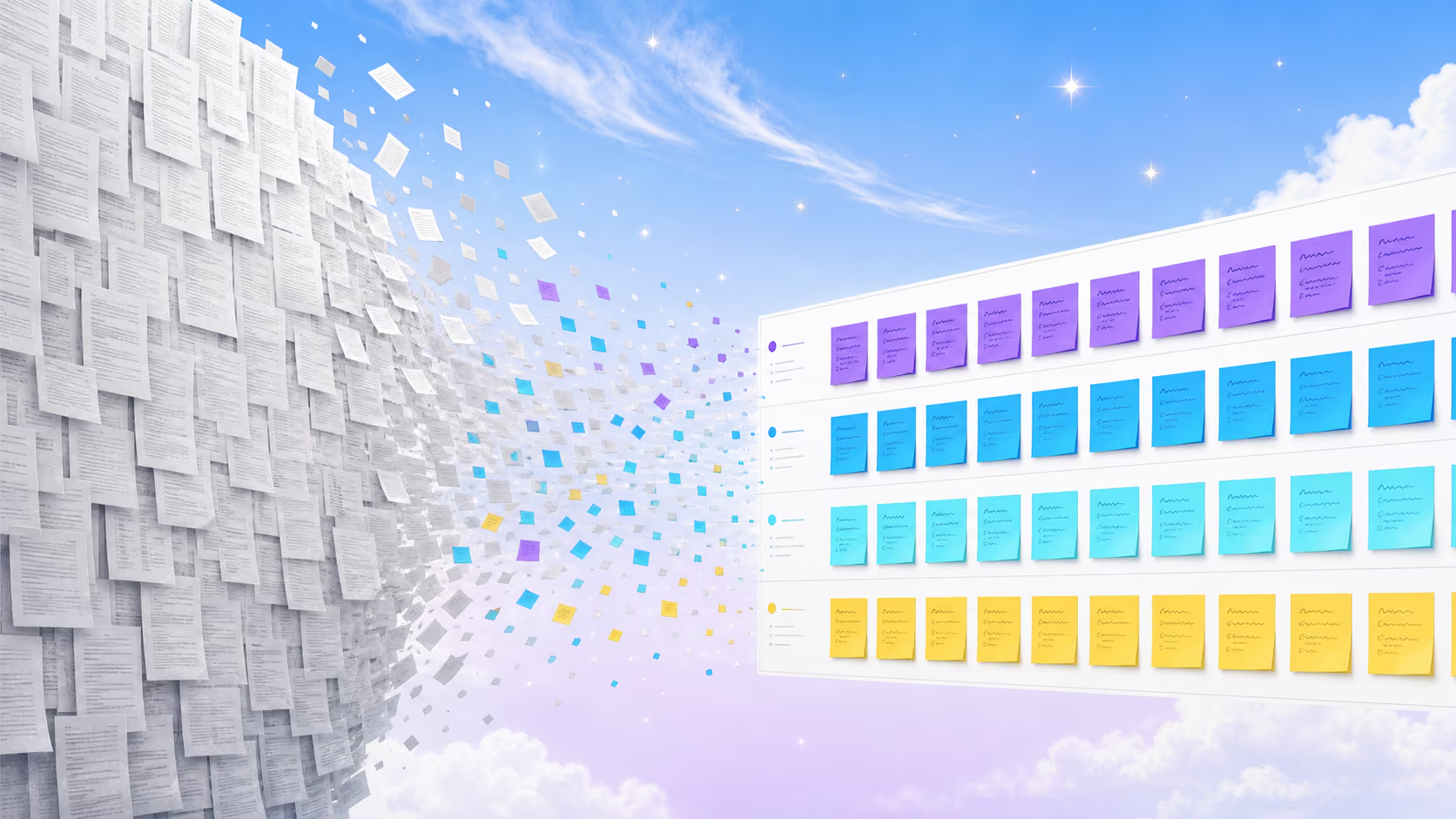
Generating documents costs almost nothing now, so we produce more than anyone can read. When the PRD runs forty pages, people skim it, nobody says what they disagree with, and everyone signs off on a different problem. In one recent survey Mike mentioned, strategy and collaboration were the functions AI had helped least. Both are mostly the work of getting people to agree.
The fix is a round trip. Have AI put the workshop material on a shared board, argue over it, then write the board back into your specs. That last step is what keeps the workshop from becoming extra work. Teams that write product requirements and specs with AI against a readiness score catch that before the sign-off.
There's a moment every heavy AI user hits that nobody talks about. You're four Claude Code sessions deep, text scrolling in four panes, and your eyes stop working. You physically cannot read another paragraph, so you walk away.
Mike Mitchell calls it the Matrix screen. He's the Strategy and Product Principal for North America at Equal Experts, and he adopted Claude Code last fall. When he described this on Stacked Sessions, I laughed, because I had the same four panes open. Then he said the part that stuck.
If one person can't read this much generated text, a team has no chance of agreeing on it.
Collaboration scored lowest of every function measured
Mike pointed to a recent survey breaking AI impact down by function:
- ~50% of organizations reported significant impact in engineering
- Under 20% in strategy
- Under 10% in team collaboration
Engineering got the investment because that's where the headcount sits. True, and boring. We've written about why faster developers alone won't save your delivery.
The last number is the one to look at. Collaboration came in lowest, less than half the rate of strategy, and both of those jobs are mostly getting a group to one conclusion. AI hands you a document by default, and a document doesn't produce agreement. It produces a thing everyone claims to have read, so whoever spoke last decides.
Nobody argues with a forty-page PRD
Product people knew this before AI showed up, which is why the job has always involved a room. We put things on a whiteboard, we draw, we erase, we edit each other's drawings. Mike's point is that people remember more of what they see than what they read, and the whiteboard is still the fastest way to get a group to one shared picture.
Then AI made it nearly free to generate a forty-page PRD, so we generated forty-page PRDs.
Mike does it too. Most product managers already do less strategy than they want because they're buried writing stories and specs. When a workshop costs two hours of prep and the AI hands you a document in ninety seconds, you take the document.
"You have to kind of restrain yourself from just sending out blobs of AI generated stuff that could very well be crap."
Every PM reading this has sent that document. I have. The result is a team that ships faster and agrees less. Nobody measures the agreeing, which is how a whole function lands under 10% and everyone acts surprised.
The workshop, rebuilt as an AI workflow
Mike connected Claude Code to Miro and has it draw the workshop material straight onto boards. The formats come from Teresa Torres's continuous discovery habits, which most product people already recognize: story maps, opportunity solution trees, assumption maps, and prototypes.
How it works is deliberately boring. He wrote instructions that define what a story map is, what belongs in each section, how a markdown file becomes a yellow sticky, and which swim lane it goes in. Once those rules exist, drawing the board is just execution.
Mike can have the boards ready in about five minutes. That number matters for what it changes. At five minutes, the workshop no longer costs more than sending the doc, so nobody chooses between agreement and speed.
The round trip is the part everyone skips
Generating the board was the easy half. The harder problem, the one Mike says took real work, is what happens after the workshop. His system reads the board back. Every sticky moved and every edit lands in the files in his repository. Five minutes after the workshop ends, his stories are updated in markdown or in Jira.
"I didn't have to go take pictures of a whiteboard, copy down yellow stickies, type into a bunch of Jira stories."
Most of the conversation about AI product tooling, including our own writing on specification quality, runs one direction. Better spec in, better code out. Mike's loop runs both ways, so the team's argument reaches the specs without anyone retyping it. That is what makes agreement cheap enough to keep doing. One-way tools just make you faster at producing things nobody agreed on.
The loop is also a place to put the rules, so security and cost get checked inside the work instead of in a review three weeks later. That's why AI agent governance is becoming its own discipline.
What does the board actually know?
Mike built all of this by hand, with Claude Code, Miro, markdown files, and instructions he wrote himself. It works, and the pattern is right.
The open question is what those boards know. A story map generated from a PRD only knows what was in the PRD. If the PRD carried a partial picture of the codebase, the board inherits that gap, the team agrees on it, and a bad assumption becomes a decision everyone signed off on. Greenfield work survives that. Enterprise brownfield software, with existing services, APIs, and years of tech debt, is where hand-rolled stacks break.
That's the problem Allstacks Product Studio is built for. Studio grounds product definitions in the real codebase, customer voice, and delivery history, then runs adversarial reviewers across the spec before engineering sees it. Different layer than Mike's boards, same bet underneath. As AI speeds up output, teams build the wrong things faster, because no single person carries the full picture.
What I'd do Monday morning
Start by measuring where you are today, on quality as well as speed. Our guide to product management KPIs covers what to measure first.
"Who cares how much faster you're going if now you're just producing crap?"
- Find where your team actually agrees. It's the moment people argue and change their minds. If a generated doc and a thumbs-up in a thread replaced it, you've found your under-10%.
- Make one workshop cheap. Pick a format your team knows and get it down to minutes, so the workshop stops losing to the document.
- Build the return path first. If the board can't flow back into your specs automatically, you've added a step instead of removing one.
Mike is a month in and hasn't run this with a client yet, which I appreciate him saying out loud. As he put it, even if you had it figured out, it'll be different next week.
Listen to the full episode of Stacked Sessions with Mike Mitchell. You can reach Mike on LinkedIn or find his writing on the Equal Experts blog.
Allstacks Product Studio is the workspace where product and engineering define, refine, and share specs grounded in the real codebase, customer voice, and delivery history, so the thing your team aligns on is the thing that survives contact with your actual software. Sign up today
FAQ
Why does AI have less impact on team collaboration than on engineering?
Engineering work can use generated output directly. Agreement between people cannot, because it depends on everyone holding the same picture, and people build that picture faster by looking at something together than by reading. AI's default output is a document. In one recent survey, under 10% of organizations reported significant AI impact in team collaboration, the lowest of any function measured.
Can you use AI to run product discovery workshops?
Yes. Mike Mitchell connects Claude Code to Miro to generate story maps, opportunity solution trees, and assumption maps in about five minutes, using written instructions that define each diagram's structure and placement rules. The second half matters more. Read the board back after the workshop, so the team's changes reach the specs without anyone retyping them.
What is a bidirectional product workflow?
A loop where AI generates an artifact, people argue over and change it in a visual space, and the changed version is written back into the specs that drive downstream work. Most AI product tooling runs one direction, better specification in and better code out. Running it both ways makes the human step cheap enough to keep doing.
Why does seat-based licensing break with AI agents?
Seat licensing assumes one human with one set of credentials. Agentic workflows mean one person plus several agents, each authenticating separately and each spending money. Procurement assumes one human, one seat, one authentication path, and most organizations haven't updated that for people plus their agents.
Will AI replace product managers?
Look at it task by task. Transcription, research synthesis, and first drafts get handed off. Deciding which problem to solve, applying domain knowledge, and building agreement across stakeholders stay human work, and new work appears around managing the skills and agent definitions that do the automating. That is why judgment matters more now, which is the case we made in the AI-native product manager's context window.
Table of contents
/ get started /