
Business Analyst to Product Manager Is a Shorter Move Than You Think
Kenyetta Hall coaches BAs into product roles, leveraging skills they already have for product management. Here's how she goes about it.

Jeff Keyes
Field CTO
Date
November 16, 2026
Tags
Best Practices

The move from business analyst to product manager is shorter than most BAs assume, and AI is making it more urgent. That was the takeaway from my conversation with Kenyetta Hall on Stacked Sessions. Kenyetta is founder and CEO of The Katalyst HQ, a product innovation and leadership development firm, and she teaches at UNC Chapel Hill's Shuford Program in Entrepreneurship. She's direct, she's funny, and she does not soften her opinions. I'd been looking forward to this one.
Her path into product started in the BA seat, and today she helps analysts, product owners, and other tech-adjacent people make the same jump.
How a business analyst became the accidental PM
Kenyetta came into product sideways. She was working in an advisory role when a reorg moved her onto an agile team as the business analyst. The team had a problem. People across the organization didn't know how to work with it, agile was still new there, and the team talked as if everyone already understood its value. They didn't.
As the front-facing person on the team, she fixed that. She built an internal brand for the team and changed how the rest of the company interacted with it. Then she ended up training the team's product owners and product managers.
She credits a very good scrum master, now her best friend, for teaching her how to manage a team and the work, write user stories properly, and understand technology at a level she says many PMs never reach. Her business background did the rest. Merging the business lane and the technical lane is what made her effective, and it's the same merge she now coaches other people through.
Along the way she also founded a startup and raised capital. It didn't work out, and she counts it as an education in team dynamics, fundraising and scope.
Why the business analyst to product manager move is shorter now
I asked Kenyetta directly whether AI is coming for BA and product owner jobs. Her answer started with a distinction most of the hand-wringing skips: startups and large organizations staff product very differently.
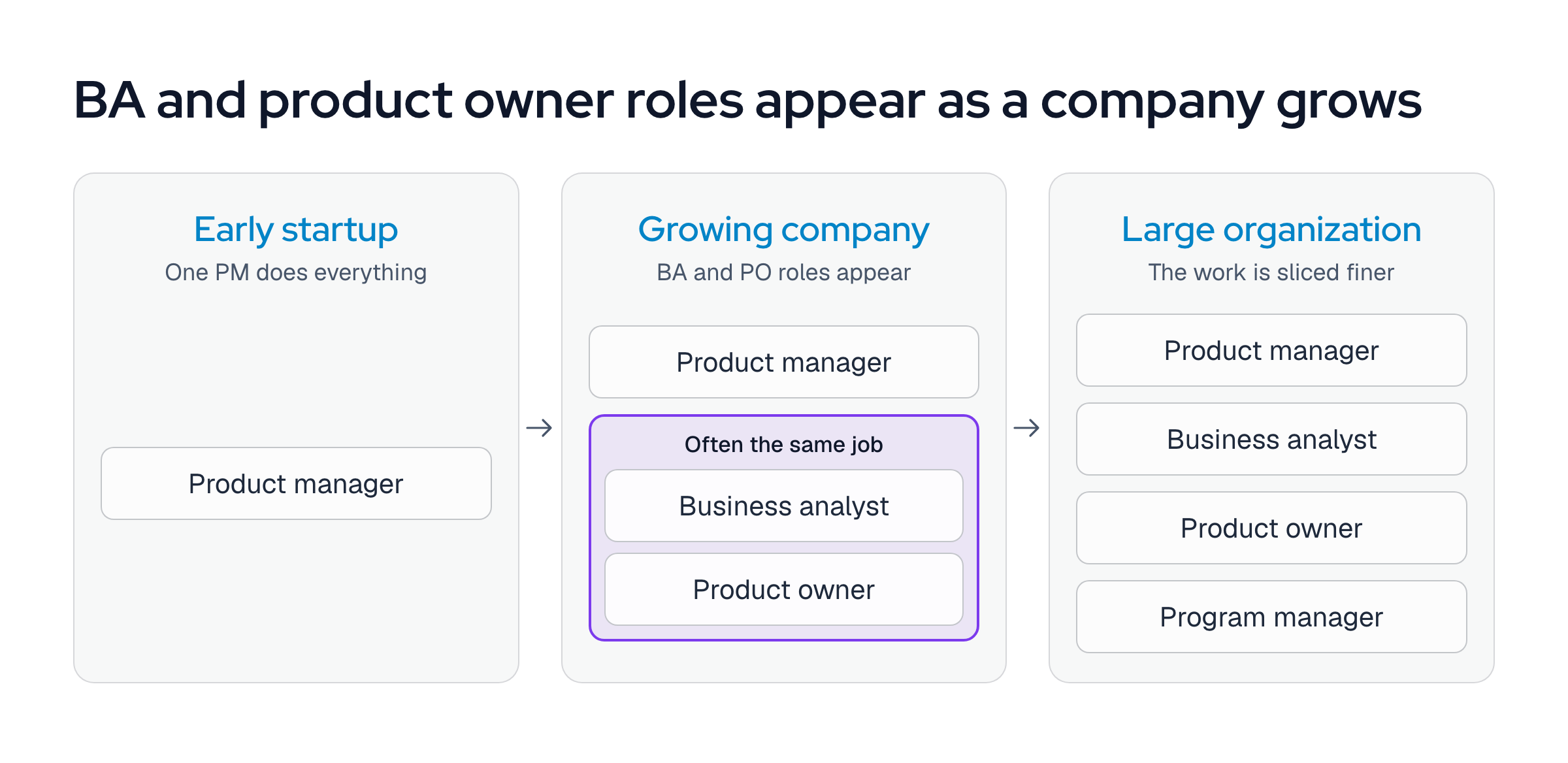
An early startup has a PM doing everything and no need for a separate BA or product owner. As a company grows and needs more product infrastructure, those roles appear, because managing teams and managing the work turns out to be harder than people expect. In large organizations, the work gets sliced finer, and you often find a BA, a product owner, a product manager, and a program manager on the same effort.
Her take on the first two roles is blunt.
"Predominantly BAs are POs. It's really not that much difference to me, depending on the organization. The lines are so blurred that it's hard to tell the difference."
And on whether BAs are ready for the PM seat:
"Believe it or not, BAs typically already have the knowledge and space to be PMs and POs. I'm gonna say this: argue with your mama. A lot of them have the skill set as well."
The outside view lines up with hers. CareerExplorer's outlook for business analysts expects documentation-focused BA roles to compress while product owner and lead tracks grow. AI is absorbing the parts of the job that were mostly writing things down. The parts that remain look a lot like product management.
So the question for a BA is less about whether the job survives and more about which habits carry them across.
Start from the outcome, then gather requirements
The first habit Kenyetta teaches is the one she thinks most BAs are missing.
"You can't gather requirements without outcomes. What are you framing those requirements to?"
A lot of analysts get stuck in a loop of just gathering requirements. Kenyetta's advice is to stay in constant conversation with your PM about outcomes. If the PM isn't articulating them, find out who can. If nobody can, start drafting a narrative around the outcomes you believe the work is meant to drive.
That last move is the pivot in miniature. A BA who writes the outcome narrative is already doing product work.
She also reframes what product is for. Product lives inside the business, and everything you build should relate to a business goal. Usually that means growing revenue, cutting expenses, or improving the experience so customers don't churn. If you can't connect your work to one of those directly, find the people who can help you connect it. Kenyetta's tip is to walk into the room as if you don't know, because people love to talk about their work.
PMs also serve two customers, in her framing. One is the internal stakeholder group, where every person has an agenda. The other is the customer. Neither wins by default. The job is keeping them in balance.
Thirty KPIs means you don't know the outcome
I tried to trigger Kenyetta with a line I hear from PMs all the time, that the team tracks thirty KPIs. It worked.
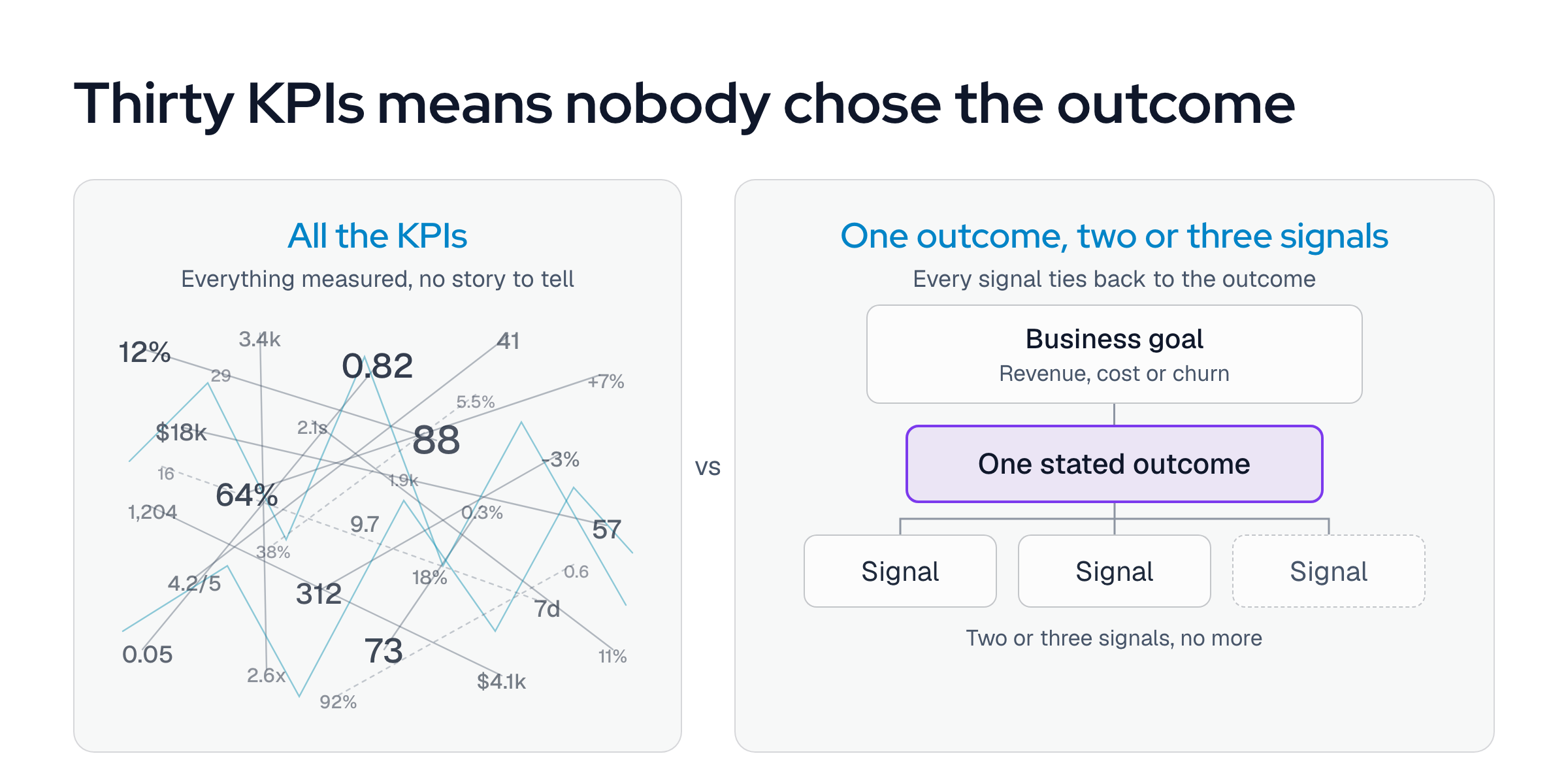
"If you have 30 KPIs, you're just bouncing around measuring everything, but it's telling you nothing. Data tells a story. What story is it getting to?"
A long KPI list, in her view, is a signal that nobody decided what outcome the work is supposed to move. The team captures everything so it can say it captured the data.
Her example was bounce rate. On its own it can be a vanity metric. Tied to an outcome, it becomes a question worth chasing. If people bounce, they probably couldn't find something. So you ask what they came for, what they clicked first, why they expected it there, and how many others did the same. The metric only earns its place once it connects to the outcome you're trying to achieve.
For a BA making the jump, this is a fast way to stand out. Bring two or three measures tied to one stated outcome, and you'll already be ahead of plenty of working PMs.
Ask whether it's feasible, and when
Kenyetta is clear that BAs and PMs don't need to become developers. She also has no patience for "we can't do that" as the end of a conversation.
"When somebody says they can't, I'm like, let's do different language. Is it feasible? Is it feasible today? Is it feasible in the next three months?"
Her approach is to keep asking until she understands why. If the data on a screen is wrong, her first question is how the data gets to the screen, and who owns the piece that's broken. Maybe there's an infrastructure change underway. Maybe a transformation is blocking it. Either way, the PM's job is to understand the dynamics well enough to say when something can be delivered.
She was emphatic that the translation burden runs both ways. Business people need to be tech literate, and technical people need to explain their work in plain language. If an engineer can't explain something to a business person without jargon, she says, they aren't explaining it right. The engineering side of that shift is real too, as AI pulls engineers into product decisions.
I'd add one thing from my side of the table. You can now ask the code itself. Point an AI coding assistant at a repository and ask it to explain how something works in plain language, and you'll get a decent answer. Kenyetta's addition was to ask it to explain things like you're five, and to learn enough fundamentals to ask good follow-ups. She compares it to reading, where letters come before words and words come before paragraphs.
I made a related case about where that literacy line sits in Should Product Managers Code?, and the feasibility question itself is the subject of Technical Feasibility Now Starts With the Product Manager.
Critically think, creatively apply, responsibly implement
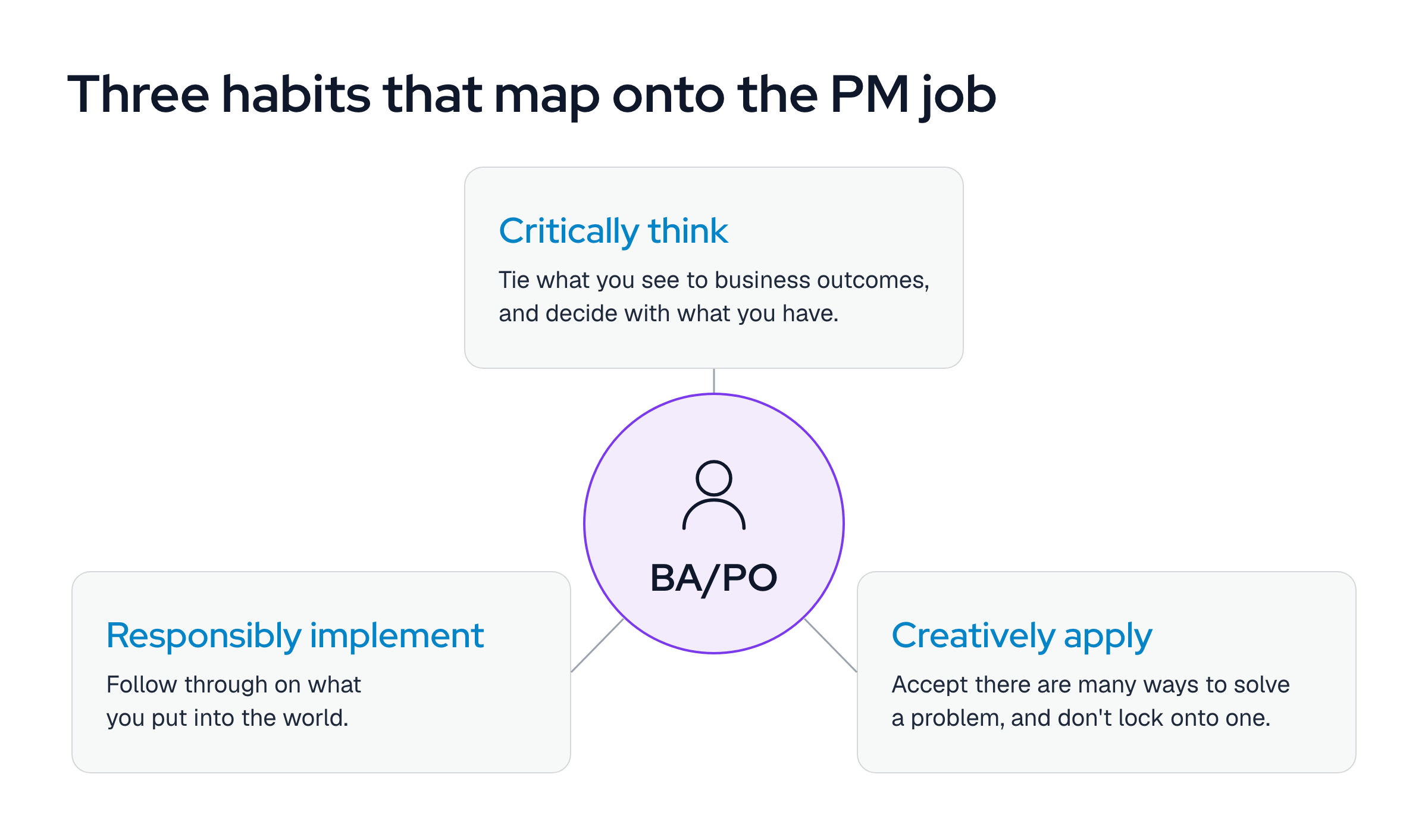
Kenyetta runs her business on a three-part framework, and it maps cleanly onto the PM job.
Critical thinking means looking at what's happening around you and your product and tying it to business outcomes. Part of that is making decisions with the information you have at the time. Analysis paralysis, she says, comes from people trying to make the right decision and then making none. Some decisions will be wrong. That's the nature of the work.
She also wants organizations to build a culture where failure is survivable.
"Failure is something you recover from. Being a failure is something you don't recover from."
Creative application means accepting there are many ways to solve a problem and refusing to lock onto one. Responsible implementation means following through on what you put into the world.
Underneath all three is a concept she teaches as being the mayor. You don't need to know everything. You need balanced knowledge of business and technology, and the ability to share a vision so people buy into it. Businesses hand down directives all the time, and people often have no idea how they fit into the new direction. Showing them is the PM's job, and Kenyetta calls it what's in it for them.
I've always described the PM role as ultimate responsibility with no authority. Kenyetta's version is cleaner. A PM, like a VP, isn't responsible for every day-to-day task but is accountable for the outcome. That means bringing people along, removing blockers, and having the conversations that move people.
Drop the jargon
One more trigger worked. I asked why PMs talk the way they do.
"Jargon is a way to make everybody look smart. Jargon makes you sound smart. Doesn't mean that you are smart."
She has sat through roadmap conversations where the PM used every right term and still couldn't say what the roadmap was, because the groundwork it depended on hadn't been done. What she wants instead is plain answers. Say what needs to happen today, whether it's feasible now, whether the right stakeholders are engaged, and whether you're measuring the outcome that matters.
For a BA stepping into the PM role, plain language is an advantage. You've spent years translating between the business and the team. Keep doing it.
Your first three moves from business analyst to product manager
- Write the outcome before your next requirements session. One sentence on what the work should change for the business. If you can't write it, go find the person who can, and treat that conversation as your first PM task.
- Cut your measures to one outcome and two or three signals. Bring that list to your PM and ask which outcome it should serve.
- Replace "can't" with "when." The next time you hear that something can't be built, ask whether it's feasible now, in three months, and what's blocking it.
Where Product Studio fits
Kenyetta's habits all come back to keeping the outcome, the requirements, and the technical reality in one conversation. Allstacks Product Studio is an agentic product management platform with specialized agents that know your business, customer, and product code, so business analysts and product owners are empowered to make product decisions.
When an engineer says a change can't be done, a product owner can simply ask Product Studio about feasibility, scoping, and breaking down the work in the right way, BEFORE they share anything with engineering. It reads the codebase and shows what the change depends on and what it would take to build, so the PO can ask what's feasible now and what's feasible in three months with the code's answer already in hand.
Request a demo of Product Studio.
Frequently asked questions
Can a business analyst become a product manager?
Yes, and Kenyetta Hall argues many BAs already have most of the skill set. The gap is usually habit. PMs start from the business outcome and frame requirements around it, while many BAs are trained to gather requirements first.
How do I transition from business analyst to product manager?
Start doing product work in your current seat. Ask your PM what outcome the work should drive, and write the outcome narrative yourself when nobody else does. Tie your work to revenue, cost or churn. When someone says a change can't be built, ask whether it's feasible now or in three months, and what's blocking it.
What is the difference between a business analyst and a product owner?
It depends on the organization. In Kenyetta's experience the lines are so blurred that BAs and POs often do the same job. Large organizations split the work more finely, while startups often fold both into the PM role.
Can a business analyst be a product owner?
Often they already are. Kenyetta Hall says that predominantly BAs are POs, and that the lines are so blurred it's hard to tell the roles apart. In her view, most BAs already have the knowledge and skill set to step into a product owner or product manager role.
Will AI replace business analysts?
AI is taking over the parts of the BA job that were mostly writing things down, and the work that remains looks a lot like product management. Kenyetta Hall adds that company size decides how the roles split. An early startup has one PM doing everything, and BA and product owner roles appear as the company grows.
What skills does a business analyst need to become a product manager?
Kenyetta Hall says many BAs already have most of them. The gap is habit. Start from the business outcome before you gather requirements, and track two or three measures tied to that one outcome. When someone says a change can't be done, ask whether it's feasible now or in three months. A BA needs to be tech literate enough to ask how data gets to a screen, and Kenyetta is clear that doesn't mean becoming a developer. Years of translating between the business and the team already give a BA the plain language the PM role needs.
Table of contents



/ get started /
