
The AI Headcount Trap: Why Cutting Engineers Won't Improve Engineering AI ROI
Gartner studied orgs that cut headcount to fund AI. Workforce reduction had zero correlation with ROI. Here's what the highest-ROI engineering orgs do.

Jeremy Freeman
Co-Founder & CTO
Date
May 28, 2026
Tags
Strategy & Thought Leadership
Industry News
The board conversation about engineering has changed. A year ago it was about velocity. Now it's about justifying the AI line item. A lot of engineering leaders I talk to are getting asked the same question: where are the returns?
The most common answer so far has been to cut engineers and point at the labor savings. Gartner studied what actually happened next, and the data is not what most executive teams expected.
What Gartner Found About Engineering AI ROI
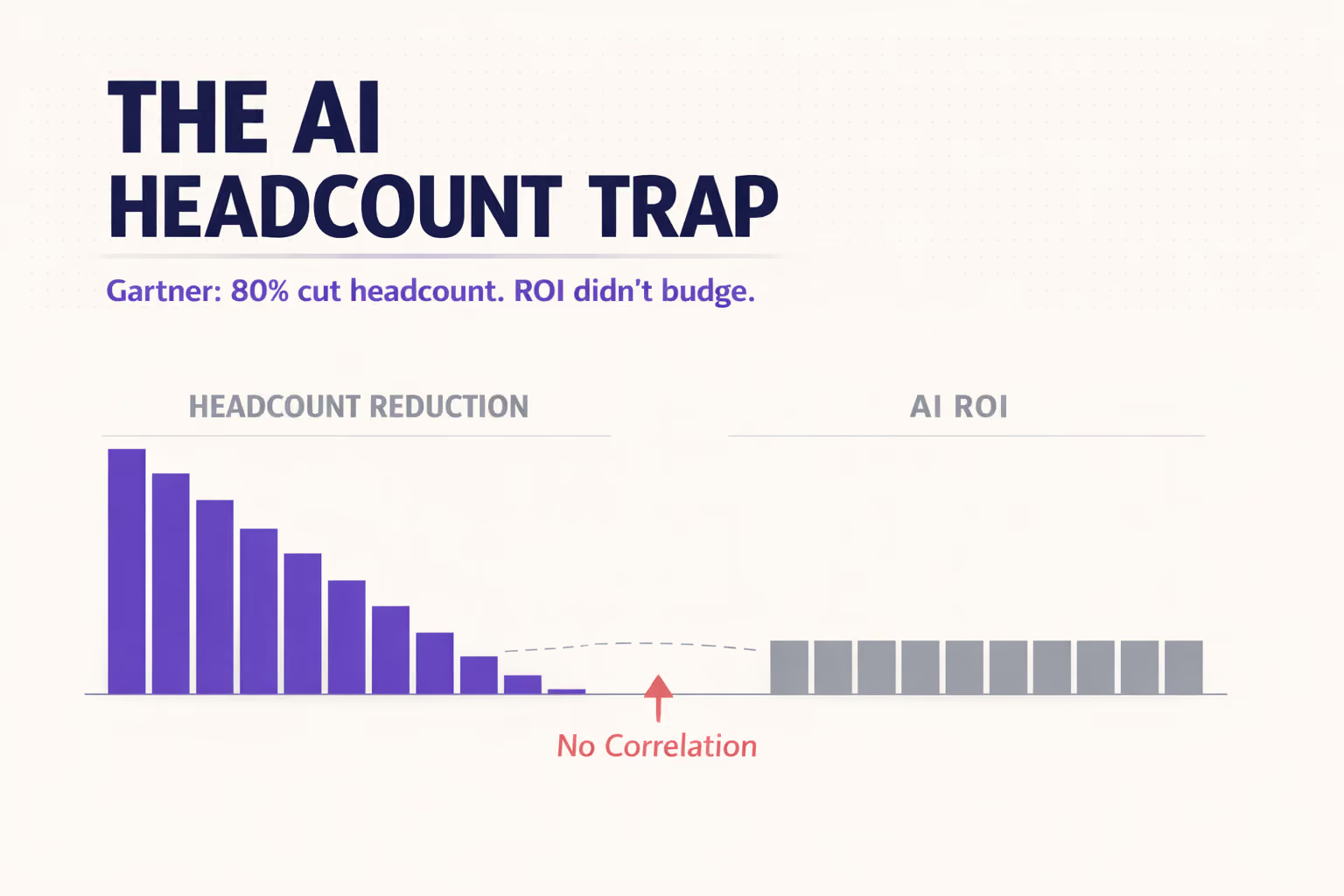
Gartner's May 2026 research surveyed 350 global executives at companies with at least $1 billion in revenue. Roughly 80% of organizations piloting or deploying autonomous AI had conducted workforce reductions. The premise was the one you've probably heard in your own building: fewer engineers, same output, better margins, more room in the budget for AI tooling.
Here's the part the labor-savings argument missed. Workforce reduction rates were nearly equal among respondents reporting higher ROI and those experiencing only modest gains or negative outcomes. Cutting headcount freed budget. It did not generate returns.
Gartner analyst Helen Poitevin put it directly: "Many CEOs turn to layoffs to demonstrate quick AI returns; however, this disposition is misplaced. Workforce reductions may create budget room, but they do not create return."
I've been thinking about why this surprises people, and I think it's because we've been treating AI in engineering like we treated outsourcing fifteen years ago. The instinct is the same: AI does the work, so you need fewer of the people who used to do the work. The math feels obvious. But it's wrong, and the reason it's wrong is structural.
Why the Math Breaks
The Gartner finding doesn't stand alone. MIT's NANDA initiative published research showing 95% of enterprise generative AI pilots fail to deliver measurable P&L impact. The lead author was specific about the cause: "The core issue? Not the quality of the AI models, but the 'learning gap' for both tools and organizations." The failure mode is integration and oversight, not model capability.
Then there's the second Gartner study, published a week after the first. Their May 2026 Global Labor Market Survey of 12,004 employees and managers found that "most leaders are mistaking basic access or adoption metrics for transformation", what Gartner analyst Swagatam Basu called the "enablement illusion" that's draining ROI from AI programs.
If you've watched a coding agent work on a non-trivial codebase, you know what's underneath all of this. The agent writes code quickly. Sometimes it writes good code. It does not know whether the spec it was handed is coherent, whether the change it's making will quietly introduce tech debt, or whether the pattern it's repeating across PRs is a signal that something in your delivery pipeline is breaking down.
Those are not coding tasks. They're judgment tasks. And they require engineers with enough context to interpret what they're seeing and act on it.
This is the work my team has been studying through the lens of pull request review behavior, which I covered in our analysis of the orchestration gap. Anthropic's own data shows developers can fully delegate only 0 to 20% of tasks to AI and actively supervise 80 to 100% of what they delegate. That ratio does not improve when you fire the supervisors. It gets worse. And the AI productivity gap makes this sharper: senior engineers get a compounding advantage from AI because they have the context to catch its failures. Cut your seniors to fund AI, and you remove the only people who can steer it.
What the Highest-ROI Programs Actually Do
Gartner has a term for the pattern they see in the winners: people amplification. "Organizations that improve ROI are not those that eliminate the need for people, but those that amplify them by aggressively investing more in skills, roles and operating models that allow humans to guide and scale autonomous systems."
This is consistent with what DORA's 2026 AI ROI report found from a different angle: returns live in the engineering system underneath the tools, not in the tools themselves. Platform quality, workflow clarity, and team alignment are the three layers that determine whether AI investment compounds or evaporates. Each of those layers is owned by engineers.
DORA also identified a J-curve pattern worth knowing about. Most engineering leaders are reading the J-curve wrong: there's a productivity dip during early AI adoption, followed by a recovery slope that compounds past the pre-adoption baseline. Organizations that read the dip as failure and respond by cutting headcount forfeit the recovery slope entirely. The dip is the tuition. The recovery is where the ROI lives, and it only happens if you still have the engineering capacity to harvest it.
Gartner forecasts 40% of agentic AI projects will be canceled by the end of 2027 due to unclear business value or inadequate risk controls. The organizations that cut the engineers responsible for business value definition and risk controls are the ones most likely to show up in that 40%.
The Visibility Problem Underneath All of This
People amplification only works if your engineers can actually see what's happening across the delivery pipeline. You can't guide what you can't see. In a mixed-contributor pipeline (humans, copilots, agents, all committing to the same repos and tickets), single-system dashboards stop being enough. If you only look at PR data you'll think every problem is a collaboration problem. If you only look at Jira you'll think every problem is a scoping problem. The actual problems have tendrils across both.
The CircleCI data my team analyzed in the engineering visibility crisis AI created makes this concrete. Feature branch velocity surged across 22,000 organizations while main branch build success rates hit a five-year low. More code, fewer reliable releases. Throughput metrics turned green and missed everything downstream.
This is the work we focus on at Allstacks. The Intelligence Engine correlates signals across GitHub, Jira, and CI/CD so the patterns that matter (review compression as AI PR volume climbs, spec quality degrading before a release, unplanned work accumulating weeks before a missed date) actually surface. Amplification is a function of visibility. Give a senior engineer the signal infrastructure to see what their teams and their agents are doing, and the AI investment starts compounding instead of evaporating.
What to Bring to Your Next Board Conversation
Don't lead with the labor savings line. The data doesn't support it as a driver of ROI, and any board with a sharp CFO is going to ask harder questions next quarter.
Lead with the amplification thesis. Show what your engineers are now able to direct, govern, and ship that they couldn't a year ago. That's a defensible, measurable, replicable story. And it's the one that maps to what the data actually shows about which AI programs are working.
Table of contents



/ get started /