
Technical Feasibility Now Starts With the Product Manager
Product managers must incorporate code understanding to improve the handoffs with engineeers and agents. Allstacks is giving product managers that knowledge where they do product work through a new code analysis capability.

Tyler Shields
Chief Marketing Officer
Date
October 2, 2026
Tags
Company News
For most of software development’s history, the jobs were cleanly split between product and engineering. Product managers owned the what and the why. They figured out which problem to solve, for whom, and why now. Engineers owned the how and when. They determined whether the thing could be built, at what cost, and how long it would take. Product managers were in an age-old standoff between when business and customers wanted something delivered, and when engineers could actually deliver it, if at all.
With the speed of AI, it can’t be a long back-and-forth anymore. Engineers are creating agentic development workflows, and product managers are building prototypes before defining any technical specification. Both put the system at risk when product managers don't consider the code, architecture, and technical constraints upstream.
Product managers see it coming. When Product-Led Alliance's State of Product Management 2026 report asked how the role will change, the most common answer (45.5%) was that it will require deeper technical understanding, such as data fluency, system architecture, and how APIs connect.
The product manager's job moved closer to the code
The product manager’s job with AI requires them to consider code and system constraints that only engineers used to know. Let’s look at the decisions that fill a product manager's week as they relate to feasibility:
- Discovery: Which ideas are worth exploring depends not only on what the customers demand, but also on what's feasible within the desired release timeline.
- Prioritization: Every tradeoff is usually based on what can realistically be built in the system. Measuring the business return of the backlog isn’t enough anymore, prioritization must take engineering capabilities into account as well.
- Definition: A requirement defines the intent and desired state, then gets descoped or changed in refinement.
Each of these decisions depends on knowing how the product is built and how it can change. Product managers have always borrowed that knowledge from engineers through refinement meetings, design reviews, and quick messages to devs. It worked, but it’s slower than AI can go.
Another survey by Product Focus states that nearly half of product managers (47%) don’t have a technical background. Respondents also named technical acumen as one of the skills product managers most need to build over the next two years. The obstacle is time and access. A large codebase takes an engineer months to learn, making it nearly impossible for a product manager to comprehend.
This doesn't mean product managers should write production code. As we argued in Should Product Managers Code?, the useful skill is knowing how the pieces fit together. Most product managers don't have the time or access to learn a large codebase well enough, so every feasibility question becomes a meeting with an engineer.
Introducing Allstacks Code Engine (ACE)
Allstacks is giving product managers access to code understanding for their product work through Allstacks Code Engine (ACE) in Product Studio. It acts like a dedicated senior engineer, answering product managers' questions about how their product's code works, helping assess technical feasibility, writing and reviewing requirements and specs, and more.
Here's how it works.
- It indexes every connected repository. ACE reads the structure of your code, meaning the functions, the classes, and how they call each other.
- It stays current. The index updates on every push.
- It shows its work. Answers point to real functions and file locations.
- It's read-only. ACE never writes code, never runs your code or build, and never crosses security boundaries in your environment. Indexed code stays under Allstacks' security practices, and Allstacks' model providers don't train on it.
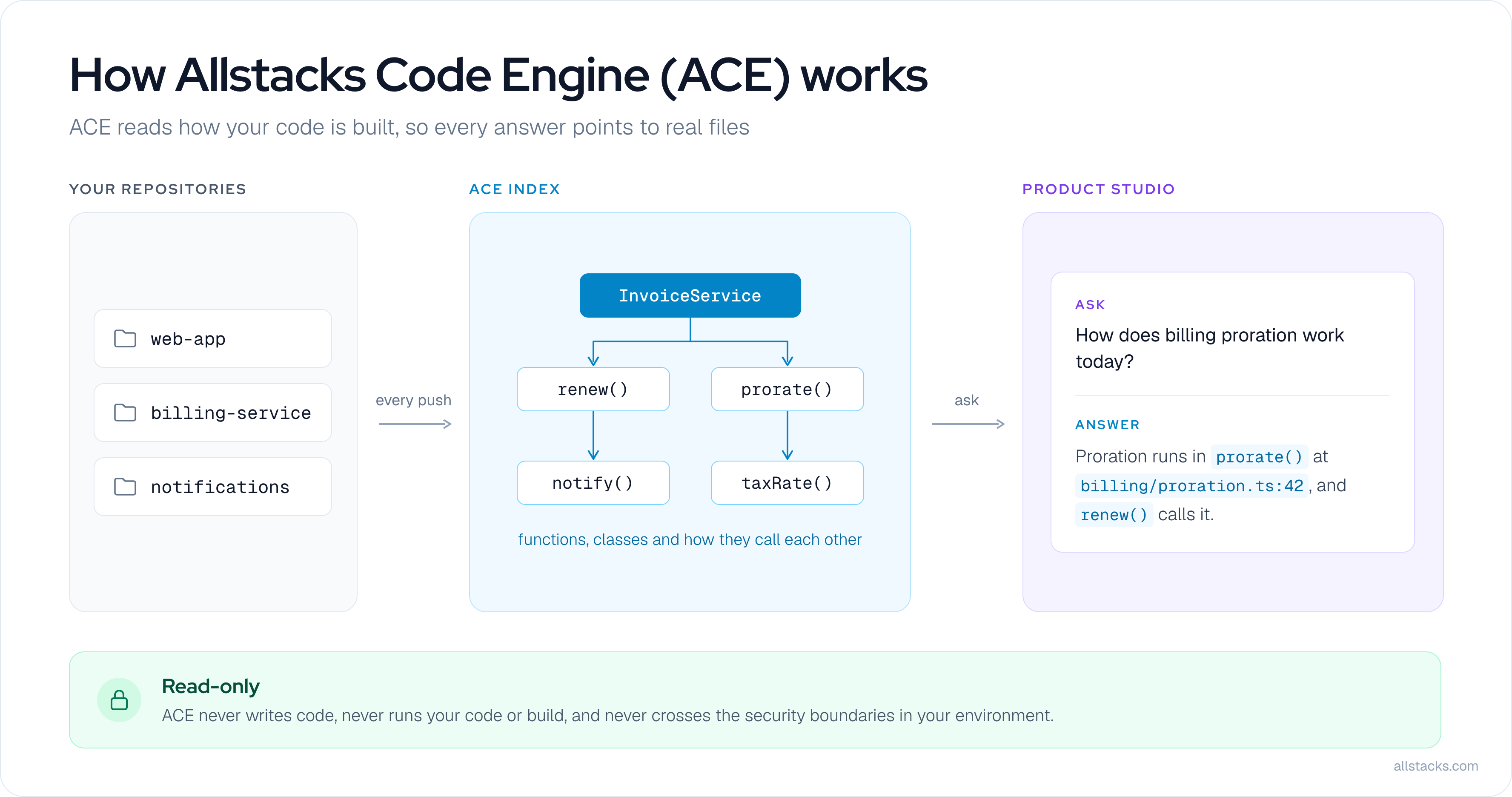
Because ACE runs inside Product Studio, the answers show up where product managers already discover, prioritize and define requirements.
What product managers can do with ACE
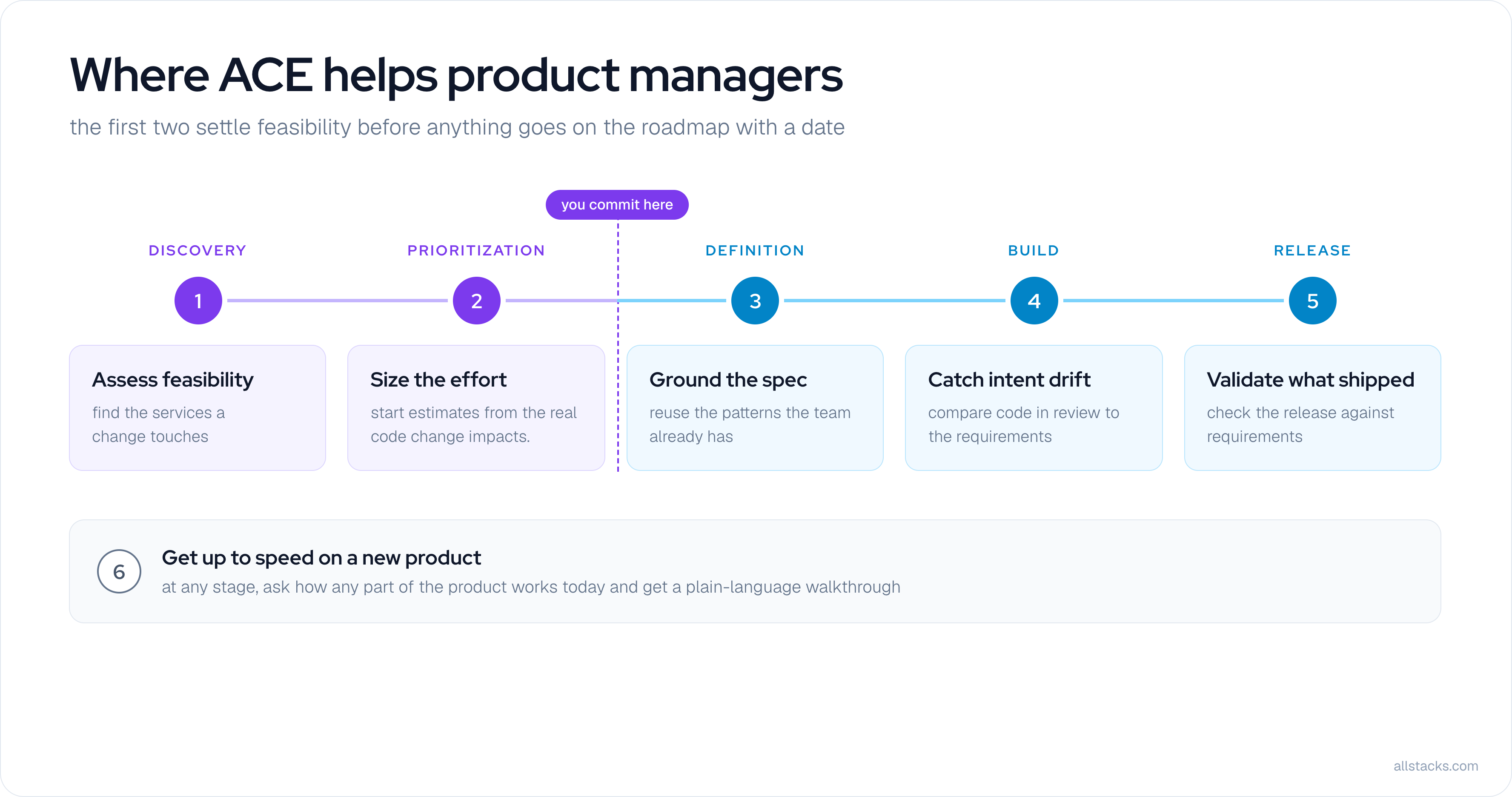
Assess product and feature feasibility before you commit
- Ask: "Which parts of the code would change if guest users could save payment methods?"
- You get: the services, files and dependencies the change touches, with the riskiest pieces called out.
- Why it matters: You find out that an idea needs a new system before it's on the roadmap with a date attached.
Size the effort accurately against the code
- Ask: "How many services does notification preferences touch, and how tightly are they tied together?"
- You get: the dependencies, the existing patterns to reuse, and the rough shape of the change.
- Why it matters: In the Product-Led Alliance report, 49% of respondents named resource and capacity constraints as the top cause of roadmap misalignment. An estimate that starts from the actual code gives you and engineering the same starting point before anyone commits people or a date.
Ground the spec in how the system works
- Ask: "Do we already have anything that sends scheduled emails, and what pattern should a new scheduled export follow?"
- You get: the modules that already do part of the job and the conventions the team uses.
- Why it matters: The gaps are addressed, tickets are in engineering terms, and you get ahead of "we need to do it this way" before refinement instead of during it.
Catch intent drift early
- Ask: "Is [feature] in review matching the requirements?"
- You get: the places where the code differs from what the requirements asked for.
- Why it matters: Engineers working with agents build quickly. Drift you catch before the push to production is a smaller impact fix than when a customer finds it and opens a support ticket.
Validate what shipped against product intent
- Ask: "Which requirements from the onboarding redesign made it into the release, and which changed?"
- You get: a requirement-by-requirement comparison against the delivered code.
- Why it matters: You know what actually shipped before customers, sales or leadership ask, and your release notes match the product.
Get up to speed on a new product
- Ask: "How does billing proration work today? Walk me through it."
- You get: a plain-language explanation of how your product actually works.
- Why it matters: Product managers are asked every day about how something works. Whether they're getting up to speed on a new product or need to validate how something works, product managers can answer with more confidence.
What changes for product and engineering
At Allstacks, our product team lives and executes daily within the Product Studio workflows. Graham Langdon, head of product and engineering at Allstacks, uses ACE with his own team and finds that:
"With Allstacks Code Engine inside of Product Studio, my engineers and I are grounded in the same facts. That shared baseline keeps conversations crisp. We align faster and don't have to spend half our time translating and providing context. This results in less time debating and more time building."
In practice, the product manager walks into planning already knowing what the code allows, and engineers spend meetings on the trade-offs only they can judge. Specs reach engineers and their agents with fewer wrong assumptions baked in. Prototypes stay closer to what the team can build, so customers see less that they'll have to walk back later.
The product managers who do well over the next few years will be the ones who know what the code allows before they commit to anything. Product managers who meet their engineering team halfway are positioned best to move into the AI-native product era.
Table of contents



/ get started /