
The Product Manager's Context Window in an AI-Native World
The AI-native product manager's real job is in judgement, taste, and the why's that AI can't replace. The challenge is capturing and communicating that context. Here's what we mean.

Jeff Keyes
Field CTO
Date
July 14, 2026
Tags
Strategy & Thought Leadership

Key takeaways
- The parts of product management AI took over were never where a PM's value lived. The value is judgment about context is necessary, and that judgment got bigger and faster.
- An AI-native product manager's job is compiling context into something an agent can use, not holding it in your head.
- Two kinds of context matter. The first kind already lives in a system and a model can read it. The second kind lives only in you, and almost nobody writes it down.
- Wiring sources together is nearly free now. The work is choosing the right slice for each decision and capturing the judgment no connector will ever have.
Something strange happens to a lot of PMs about three months into going AI-native. The tools do more of the job than ever. They draft the docs, summarize the calls, break down the work. And you feel less in control, not more. More gets produced, and less of it feels like yours.
The parts AI took over were never where your value lived. Your value was the interpretation of the context underneath the work, the judgment about what's actually going on and what's worth doing. That part didn't get easier. It got bigger, and it got faster.
Your context graph got bigger than your head
Product context used to compile slower than the decision
For most of my career in product management, the context I needed day-to-day to make decisions and prioritize product direction was manageable. Back then, I had time to gather and keep it organized. When I was on the Microsoft Office team, we were building features that shipped two years out. That runway let you assemble context incrementally: a customer visit here, an architecture conversation there, a competitive read the next quarter, all of it landing slower than you could absorb it. Agile tightened the loop but kept the same move: take a slice that's already been decided, gather what it needs, and ship it. Both worked because context arrived more slowly than the decision required it.
That's over. Context now arrives faster than any release cycle, from more directions, and it has to be structured better than a notebook full of shorthand or a Google Doc with notes. A good decision today, at the speed we need to make them, must simultaneously pull on:
- Product usage: what customers do in the product, not just what they said on the call
- Internal and external conversations: what the Slack threads, the idea portal, and this week's three customer-success meetings are all asking for
- Incident and bug reports: what last night's incident says about where the system is brittle
- Code and architecture: what the codebase will and won't tolerate
- Past decisions: what you killed eighteen months ago and why
- Executive strategy: what the exec push is this quarter
- Contractual agreements: what customer contracts forbid or require
- Financial impacts: what the thing costs and whether it clears the margin.
No one can reliably retain that in their head and communicate effectively as fast as we need to move. The PMs who think they do are making confident calls off a third of the picture.
The new job is making your product context legible for people and AI
Handling a larger set of context at the pace we are moving now isn't necessarily the hardest part. Making it legible and referenceable is the harder challenge. You're working with agents all day now, and an agent can only use context that's written down, organized in a way to understand relationships, and consistently reachable. For years, I took notes at every meeting, organized by person, company, customer, partner, and feature, so I have plenty of information to work from. When I got my hands on Claude, my first move toward going AI-native was to hand it all over to the LLM to make something of it. It did not handle it well. I was surprised when it couldn't do much with my shorthand, my abbreviations, and the things I left out because I intuitively know them. These created barriers for any kind of agentic work I tried.
Communicating your product knowledge and making it referenceable to a model are two different problems.
A teammate works off your half-formed sense of a situation and generally knows to ask when something doesn't add up. A model works off exactly what's written down, and when something's missing, it typically assumes and keeps going. That's where problems with agents begin. Just as it was before, people don't care as much about your outputs as they do the reasoning behind them. That reasoning comes from the breadth and depth of context behind it. That's what the agent needs.
The job we have now requires product managers to compile and maintain all that context in a way that you AND the machinery can use to automate tasks and make decisions you can trust. An AI tool for product management either does that compiling for you or it does not. Most can connect, not many can carry the relational context like you can.
Compiling it doesn't mean piling it up. A model gets worse as you stuff more into it, even when every token is relevant, because attention is a fixed budget and a bigger pile thins it (read more about context rot). The target can't be to dump your whole world into a chat window. If you connect everything with no structure, you've built yourself a data lake. A data lake with a million connections is still a swamp (context graph vs. data lake).
What earns its keep is a context graph: the same collection of data, structured so the relationships are explicit and the system can surface the small, right slice for the decision in front of you and leave the rest within reach. It's a reservoir of data with meaningful relationships, so you can feed the model a smaller, sharper working set to work from.
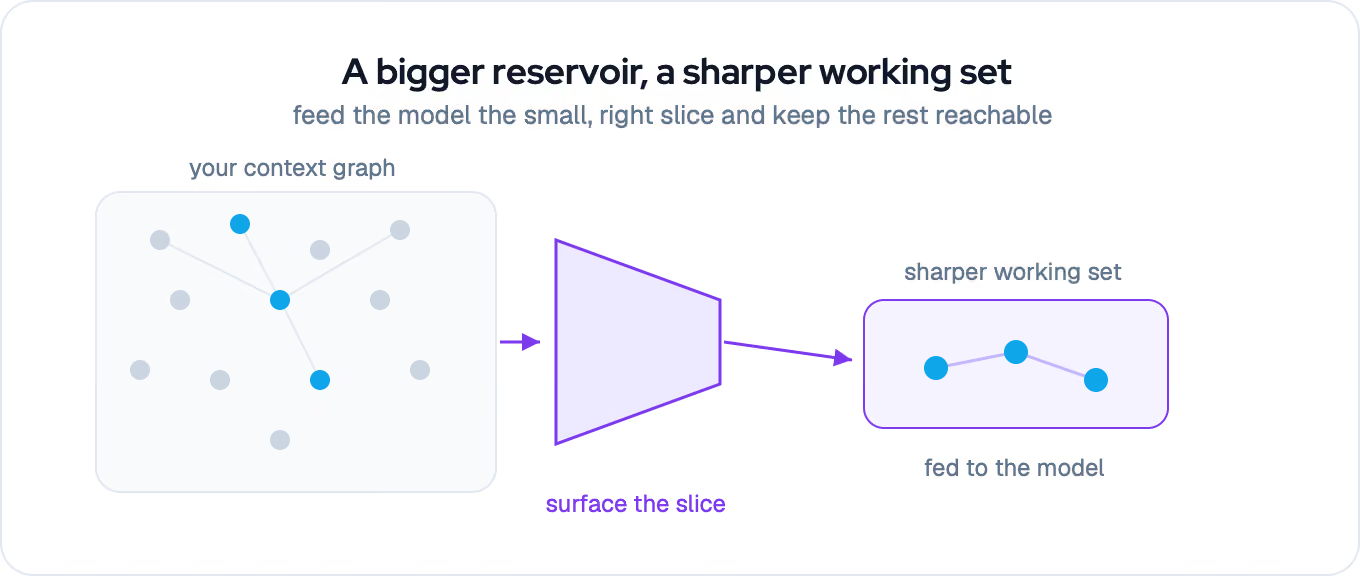
So, the real advantage is not dependent on how much information you can pile up for it to look at. What matters for the product manager to think about is what's actually worth having in the graph, and that splits in two.**
There are two kinds of context, and the line between them is the whole game
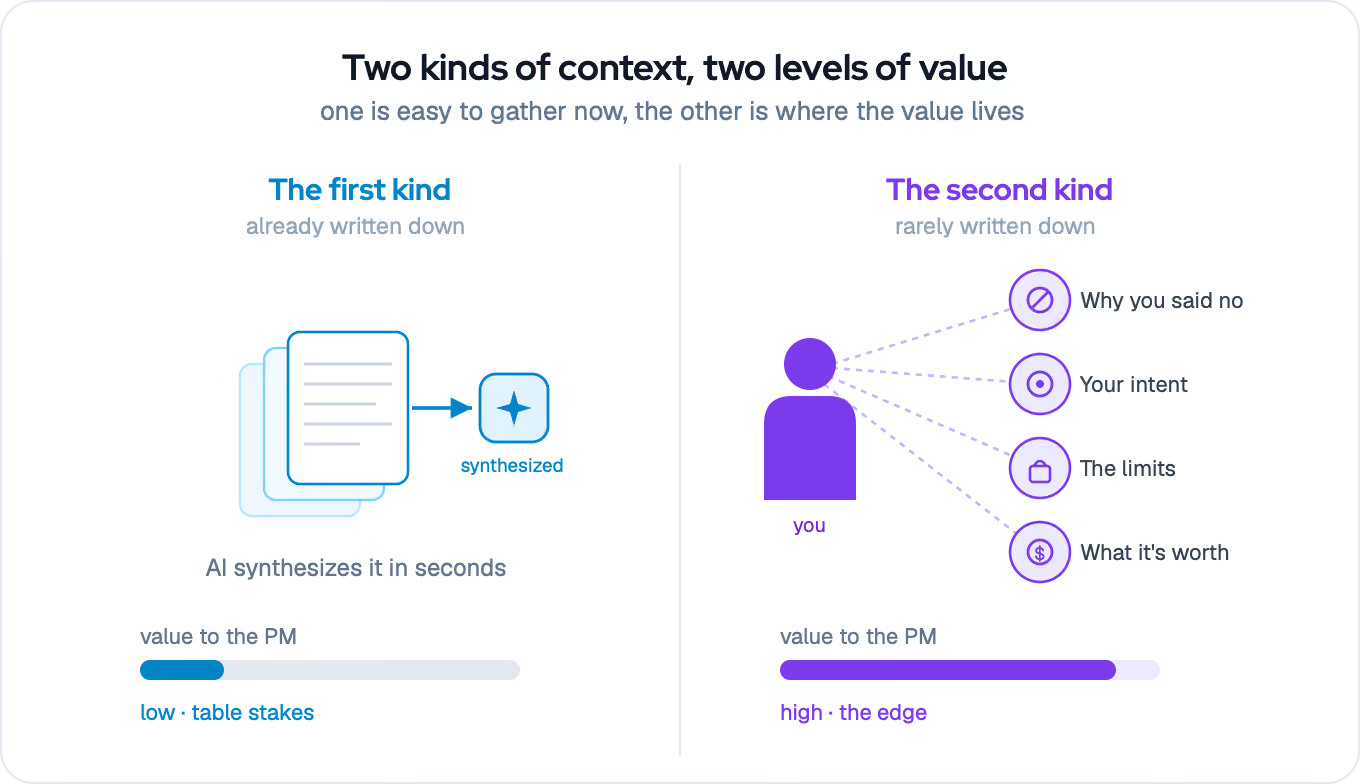
The first kind: context a machine can reconstruct
This already lives in a system somewhere - a recording, a list, a document, etc. Wire it up, and a model reads it without your help. It's what the slide-deck version of "context" usually means. From my experience, there are six classes of context most useful, because you don't need to give it everything. A machine can reach all of it in principle. That doesn't make it easy, feasible in your stack, or worth the wiring for the work you actually do. Know the purpose of each class and how it supports your decisions.
- Customer voice. What customers say and what they do. What customers say: this includes calls, tickets, interviews, sales objections, and, increasingly, surveys and review sites (Gong, Grain, Zendesk, ServiceNow, Intercom, G2, the app stores). What customers do: user behavior, funnels, adoption, the feature opened once and abandoned (Pendo, Amplitude, Mixpanel, FullStory). Then tie both back to who's actually paying using your CRM (Salesforce, HubSpot). PMs are strong on the say side, and AI made synthesizing hundreds of calls nearly free, which is exactly why it stopped being an edge. Most of us are still a quarter late on the do side, reading a dashboard instead of steering off it.
- Delivery history. What engineering is actually doing beyond what is reported in statuses. Velocity, how the last fifty features really went, where work piles up, what's been reworked three times, what's stuck right now (Jira, Linear, Azure DevOps, and the pull-request history behind them). It's the richest signal on what's truly buildable, and the one exception in this list. It's reconstructable in principle, but on most teams, it's never reconstructed, scattered across tickets, pull requests, and two senior engineers' heads. Wire it together, and you're making decisions based on the ground truth most are guessing at.
- Code & architecture. Repos, services, APIs, tech debt (GitHub, GitLab, Bitbucket). What the code makes easy, what it fights, which service owns what, where quality is trending. This keeps a definition honest about what's feasible instead of what sounds feasible. A model that sees the architecture won't spec a feature that cuts across four services nobody wants to touch.
- Work & team. Assignments, workload, ownership history, who knows the part of the system you're about to change. This turns "we should build X" into "here's who'd build it and what they'd drop to do it." The difference between a roadmap and a plan.
- Meetings & conversations. This is where most product decisions actually get made, and it's the pile that's been captured the least. Every standup, review, and customer call now goes through a recording tool (Granola, Krisp, Zoom, Google Meet, Gong, Teams), and the follow-up lives in Slack or Teams. The transcript is finally reachable in a way it never used to be. What's missing is the wiring that turns what got decided in the room into something the rest of the system can act on, instead of a recording no one opens again.
- Design & prototypes. Three things that used to be one. Static designs and wireframes (Figma, Sketch), and increasingly the interactive prototype a PM spins up directly (v0, Lovable, Bolt, Replit). The pull toward a clickable prototype over a flat comp keeps getting stronger because a working thing surfaces the gaps a static screen hides. This is where the definition, the mockup, and the shipped thing either agree or silently drift. Wired in, spec and prototype and code get reconciled against each other instead of each team working off a stale copy.
- Market & competitive. What's moving outside your walls. Competitor changelogs and pricing pages, analyst notes, review sites, the win/loss on deals you lost. A model can pull a lot of this off the open web with no connector at all. It's the context that tells you whether the thing you're about to build is table stakes, a differentiator, or a race that's already over.
- Strategy & docs. The written strategy: initiatives, OKRs, roadmap docs, whatever made it into Confluence, Notion, or a roadmap tool. It's the thinnest pile, and the reason it's thin matters. The written strategy is reachable; the intent under it, why this, why now, what "good" means here, almost never got written down. That's the handoff into the second kind, where the real strategy lives.
These six classes of context are pretty much table stakes now with the power of AI synthesis. The moment a competitor wires up the same calls and the same tickets, whatever edge you had sitting there is gone. Arguably, delivery is the one place I'd still say that advantage exists, and only because so few teams have actually assembled it. Everywhere else, the edge is this second kind below.
The second kind: context that only lives in you
The product context that lives in your brain is the most important. A model can't read this off any system because it was never written down for anything other than your own memory. It's the part that's yours, and where the value you can bring comes in clearly. It's your product taste, intuition, a feel for the business bet, discipline about experiments and evals. Call it what you want. For me, there are four things, and none of them make it into tickets or documents consistently.
- Why you said no. The thing you killed eighteen months ago, the integration you passed on, the rewrite you talked yourself out of. A model can read your codebase. It can't read the meeting where you made the call unless someone wrote it down or it was recorded where it can be reached. This is decision memory, the highest-leverage layer a machine can touch, because it's the one a machine can't reconstruct for itself. It's rarely captured in a way it can be retained in memory, besides an email or conversation. Without it though, your agent re-proposes or worse, builds, exactly what you already rejected, because as far as it knows, the question was never asked.
- What you're actually trying to do. The intent behind the roadmap. What you're on the hook to move this quarter, what you're optimizing for, what "good" means for this bet, how much risk you're willing to carry to get there. If "why you said no" is the why behind past calls, this is the why right now. A model invents it if you don't hand it over, and it invents something plausible and wrong, then optimizes everything downstream toward it.
- What you're not allowed to do. You start with something simple. The architect says it can't be built that way. Security flags the threat model you skipped. Then the contract clause, the compliance line, the data you can't move across that boundary. None of that ends up clearly in a prompt, a spec, a ticket. A model that doesn't know a constraint doesn't slow down for it. It ships you the thing you're not allowed to build, and you find out too late.
- What it's actually worth. Cost to build, what someone will pay, where the margin is, whether it clears at all. This dimension quietly fell out of the modern product manager's context. Customer signals split into what they say and what they do, engineering swelled into the whole delivery picture because they can build faster, and the economics dropped off the table. It's the most reliable blind spot in the job, and it's the language the people who fund you actually speak.
Product managers are good at the customer layer, and that's exactly the layer a machine can already get. The part that's genuinely yours, the why, the not-allowed, the what-it's-worth, is the part almost nobody writes down anymore. I see so many product managers building their whole product management operating system on the first half of the context and never systematizing the second half. That's backward, and with a machine in the loop, it's expensive backward, because the model doesn't fill those gaps with judgment. It fills them with a confident guess, and you pay for it after every turn, cleaning up what it got wrong.
Build it or buy it
Either way, someone has to assemble these layers of context, because none of it assembles itself. The reasons why we did something may be in old Slack threads and a doc no one updated. The constraints are in the architect's head. The economics are in a finance model you rarely look at. It was never written and compiled for a machine, because until recently the only thing that would read it was you.
Building it yourself
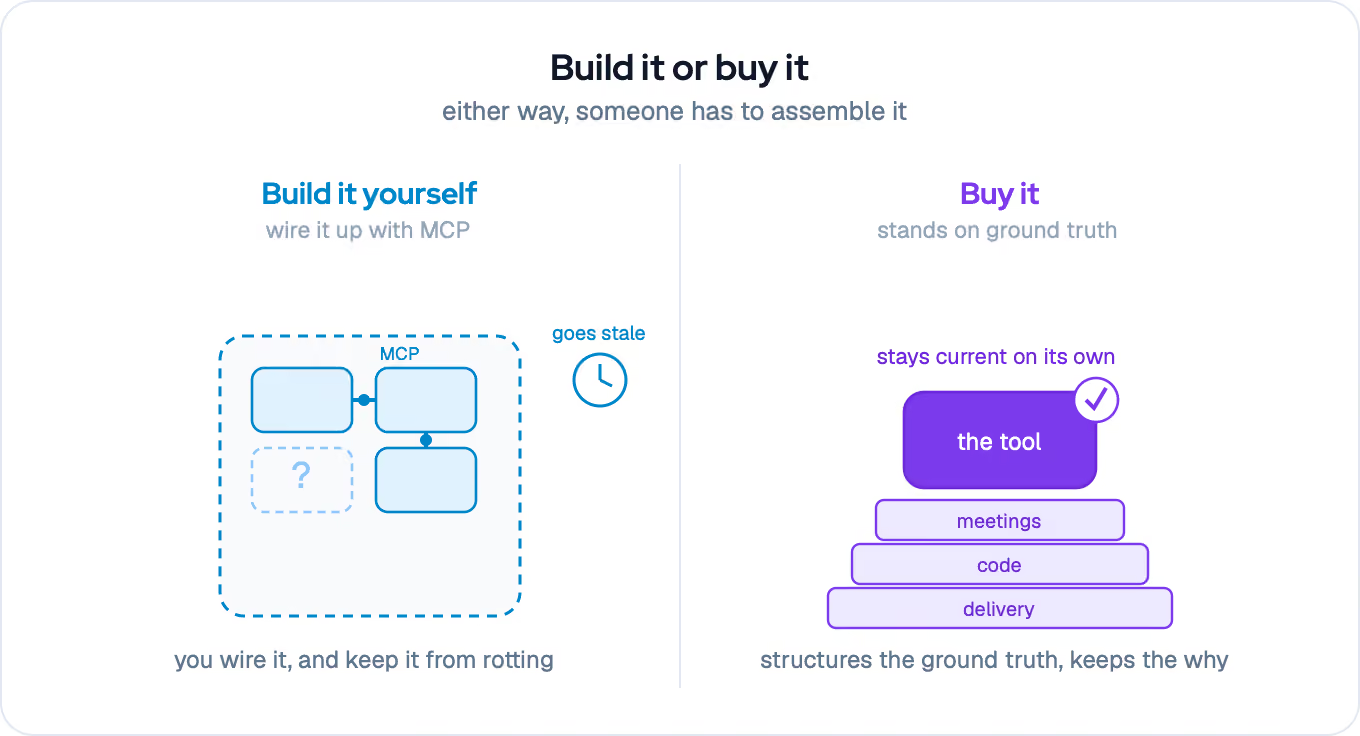
You can build it, and more teams are, because the pieces are more reachable than they've ever been. Wiring the sources up is the easy part now. MCP turned each new connector into a few lines of config, so plugging in your tickets, your repos, your calls, and your analytics is nearly free. The hard part is everything MCP doesn't do: deciding what the model should see for the decision in front of it, keeping the rest out of the way, and writing down the second-kind context no connector will ever have. That's the part most challenging to build yourself, and the DIY version goes stale quickly if you don't continually tend to it.
Buying it
If you buy instead, I'll be upfront about my bias before I hand you a checklist: this is the exact list we built Product Studio to pass, so weigh it knowing where I sit. The questions hold up no matter whose tool you're looking at. Screen hard for whether there's any ground truth underneath. Most "AI for PMs" is a chat wrapper sitting on the customer layer, because feedback is the context lying out in the open. The questions I encourage you to ask when evaluating an AI product management tool:
- How many of the classes does it actually see? Feedback is the easy one. Does it also stand in delivery, code, and the meetings where the decisions got made?
- Does it pull the right slice for the task, or connect everything and dump it in? Wiring to the most sources isn't the win; a tool that floods the model drowns it. You want the one that structures the relationships and surfaces the small, relevant set for this initiative, so an enterprise spec isn't polluted by SMB feedback, and keeps the rest reachable.
- Does it stay current on its own, or is it a folder you upload to and forget?
- Is there anywhere to capture the second kind, the why and the constraints and the calls you've made, or does it only ingest the first?
A tool that only reads the customer layer is selling you the part that was already table stakes. The one worth paying for stands in the ground truth, structures it into something an agent can actually reason over, and gives you somewhere to put the judgment.
Once the context is assembled, two things change
Things fundamentally change once you have this in place:
First, creating and validating the definition becomes a craft again. It has to be precise enough for an agent to execute and verifiable enough for you to check, because the thing reading it won't argue back or fill the gaps for you. I went deep on that in The PRD Was Never the Point.
Second, you stop grading yourself on how much you produce, because AI inflates output until the number stops meaning anything. You watch the mix of what you actually spend capacity on instead. That's Flow Distribution.
What good looks like
This is what we've been building toward at Allstacks with Product Studio. A workspace for product management shouldn't make you assemble your context graph by hand every single time. It should already stand in the delivery and code reality, have your past judgement calls, so the definition you write is grounded in what's buildable and what's already been decided, instead of floating in a chat window, guessing about a system it's never seen. The harder half is the context that only lives in you, the why, the constraints, the calls you've already made, and the place to capture that is where you're already making them.
If you want to see what it looks like when the context graph is wired in instead of carried around in your head, sign up for Product Studio and point it at your own work. And if you want to compare notes on what belongs in a PM's context graph, I'm on LinkedIn at linkedin.com/in/jeffdkeyes.
FAQ
What is an AI-native product manager?
An AI-native product manager works with AI agents on most of the drafting, summarizing, and task breakdown, and spends their own time on the judgment underneath it: what the context means and what's worth doing. The role shifts from holding context in your head to compiling it so you and the agents can both use it on every decision.
How should a product manager use AI?
Use AI for the reconstructable work, synthesizing calls, summarizing tickets, breaking down tasks. Spend your own effort writing down the context a model can't reach: why you said no to past ideas, what you're trying to move this quarter, what you're not allowed to build, and what the work is worth.
What is context engineering for a product manager?
Context engineering is structuring the material behind a decision so a model surfaces the small, right slice instead of drowning in everything. For a PM it means making your notes and decisions legible to an agent, not piling more into a chat window.
What is the difference between a context graph and a knowledge graph?
A knowledge graph maps entities and their relationships as general reference. A context graph structures the material behind a specific product decision, customer voice, delivery history, code, and constraints, so an agent can surface the right slice for the decision in front of you. See context graph vs. data lake for why structure beats raw connection.
Table of contents



/ get started /